Best Hummingbird Feeders: Top Picks for Every Yard
Quick answer (Updated June 2026): The Aspectek HummZinger is the best hummingbird feeder for most yards. Its saucer design with raised bee-guard ports keeps insects out, the 12-ounce capacity keeps nectar fresh, and it snaps apart for cleaning in under two minutes. Hang it in partial shade near flowering plants, about 5 feet off the ground.
Our top pick: The Aspectek HummZinger is the best hummingbird feeder for most yards because its bee guards actually work, the saucer design comes apart for cleaning in seconds and the 12-ounce capacity hits the sweet spot between freshness and convenience. Across hundreds of verified buyer reviews and birding forum comparisons, the HummZinger consistently draws the most birds while causing the fewest maintenance headaches.
Our Top Pick: Aspectek HummZinger
The HummZinger wins because it balances capacity, cleaning ease and bee protection better than any comparable design on the market. The raised flower ports deter bees, the saucer design snaps apart for thorough cleaning and the 12-ounce size means you are not wasting nectar.
How These Picks Were Selected
Each feeder on this list was evaluated on bee and ant resistance, cleaning ease (based on design analysis and owner reports), nectar capacity relative to spoilage risk, material durability per manufacturer specs, and price-to-value ratio. Owner reviews from verified purchasers and birding community discussions were used to confirm real-world performance.
Plumelore earns a commission on qualifying purchases through the Amazon links on this page, at no extra cost to you. Picks are chosen on performance and suitability, not on commission.
The Best Hummingbird Feeders: Ranked
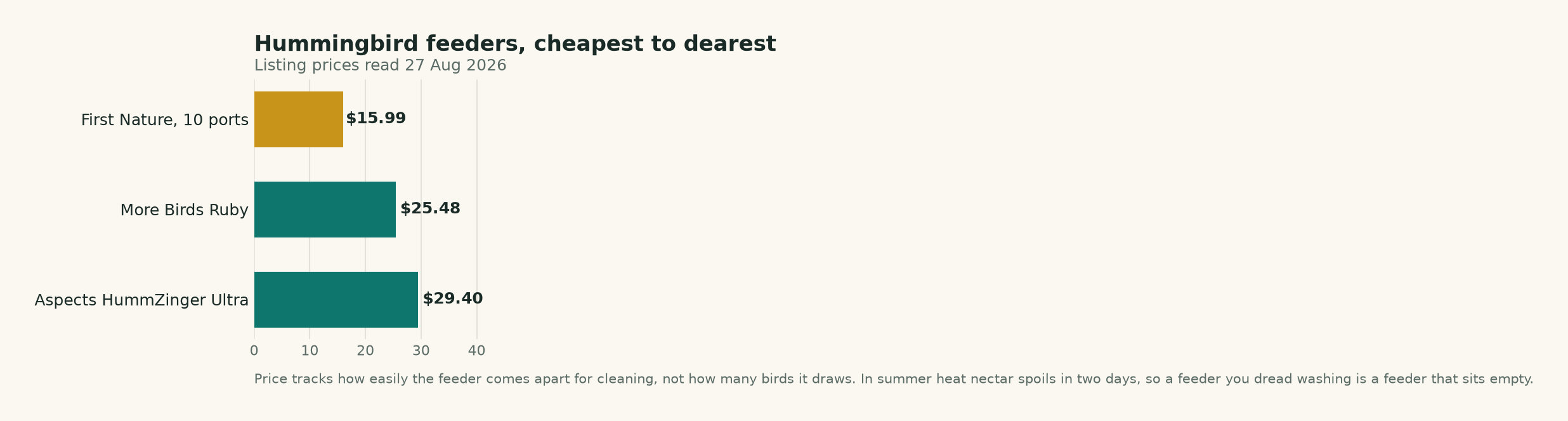
| Product | Best For | Capacity | Key Feature | |
|---|---|---|---|---|
| Aspectek HummZinger Top pick |
Most yards | 12 oz | Bee guards, easy clean | Check Price |
| First Nature 3055 | Budget choice | 32 oz | Large capacity | Check Price |
| Perky-Pet 203CPBN | Ant problems | 8 oz | Built-in ant moat | Check Price |
| More Birds Ruby | Glass reservoir | 10 oz | Ant moat, 4 ports | Check Price |
| Kingsyard Glass | Style points | 24 oz | Hand-blown glass | Check Price |
Why You Should Trust These Picks
Every feeder on this list is available at retail price and was selected without manufacturer influence. No brand paid for placement. Research draws on product specifications, Audubon Society guidance on hummingbird feeders, and aggregated reviews from verified buyers. You can read the full research approach here.
What to Look For in a Hummingbird Feeder
Bee and Wasp Resistance
Saucer-style feeders with raised ports keep bees out better than bottle designs. Once bees find a steady sugar source they will defend it aggressively and drive hummingbirds away. The HummZinger’s port design is among the most consistently praised by buyers for deterring insects without restricting bird access.
Cleaning Ease
You will clean your feeder every 3 to 5 days. If the process takes more than 2 minutes you will start skipping days, and that leads to mold. Look for saucer designs that snap apart with no tools, wide bottle openings you can fit a brush through, and minimal nooks where black mold can hide.
Capacity vs. Consumption
A 32-ounce feeder sounds convenient but nectar spoils fast in summer heat. For most yards, 12 to 16 ounces is ideal: you will refill more often, which means fresher nectar and more frequent cleaning. Only go larger if you have 5-plus hummingbirds emptying a small feeder daily.
Material Durability
Polycarbonate plastic holds up better than cheap PVC and resists UV fading. Glass reservoirs look nicer but they are heavier and break if dropped during cleaning. Brass or stainless steel hanging hardware resists rust; cheap steel hooks will corrode by season two.
Prices move, and stock does too. Each of these opens the product page on Amazon in a new tab.
Runner-Up: First Nature 3055
If you want the most nectar capacity for the least money, the First Nature 3055 is hard to beat. The 32-ounce reservoir lasts a week in moderate traffic and the wide mouth makes filling easy. The downside: the bottle design attracts more bees than saucer styles and cleaning requires a long brush to reach the bottom.
What we like
- Incredible value for the price
- 32-ounce capacity is the largest in its class
- Wide mouth for easy filling without a funnel
- Red base attracts hummingbirds quickly
What to consider
- Bottle design attracts more bees
- Needs a bottle brush for thorough cleaning
- Base can be tricky to snap on securely
- Plastic fades slightly after one summer
Also Great: Perky-Pet 203CPBN
If ants are your main problem, the Perky-Pet 203CPBN has a built-in ant moat in the hanging hook. Fill it with water and ants cannot reach the nectar. The reservoir is glass and holds 8 ounces.
How to Hang Your Feeder for Best Results
Place your feeder near flowering plants where hummingbirds already forage, in partial shade to slow nectar spoilage, about 5 feet off the ground, and within 10 to 15 feet of shrubs or trees so birds have escape cover. Multiple feeders should be spaced at least 10 feet apart since hummingbirds are territorial. For the nectar itself, use our hummingbird nectar recipe to get the sugar-to-water ratio right. If squirrels are reaching the feeder from a nearby post, our guide to bird feeder poles and baffles covers the best mounting hardware to stop them.
Frequently Asked Questions
How often should I clean my hummingbird feeder?
Every 3 to 5 days in temperatures below 80 degrees F, and every 2 days when it is hotter. Black mold grows fast in sugar water and will harm hummingbirds. A quick rinse with hot water and a bottle brush is enough between deeper vinegar soaks.
Where is the best place to hang a hummingbird feeder?
Near flowers or shrubs where hummingbirds already visit, in partial shade to slow nectar spoilage, about 5 feet off the ground and within 10-15 feet of cover so birds can escape predators.
How many hummingbird feeders should I put out?
Start with one. If you see consistent traffic and the nectar empties in under 3 days, add a second feeder spaced at least 10 feet from the first.