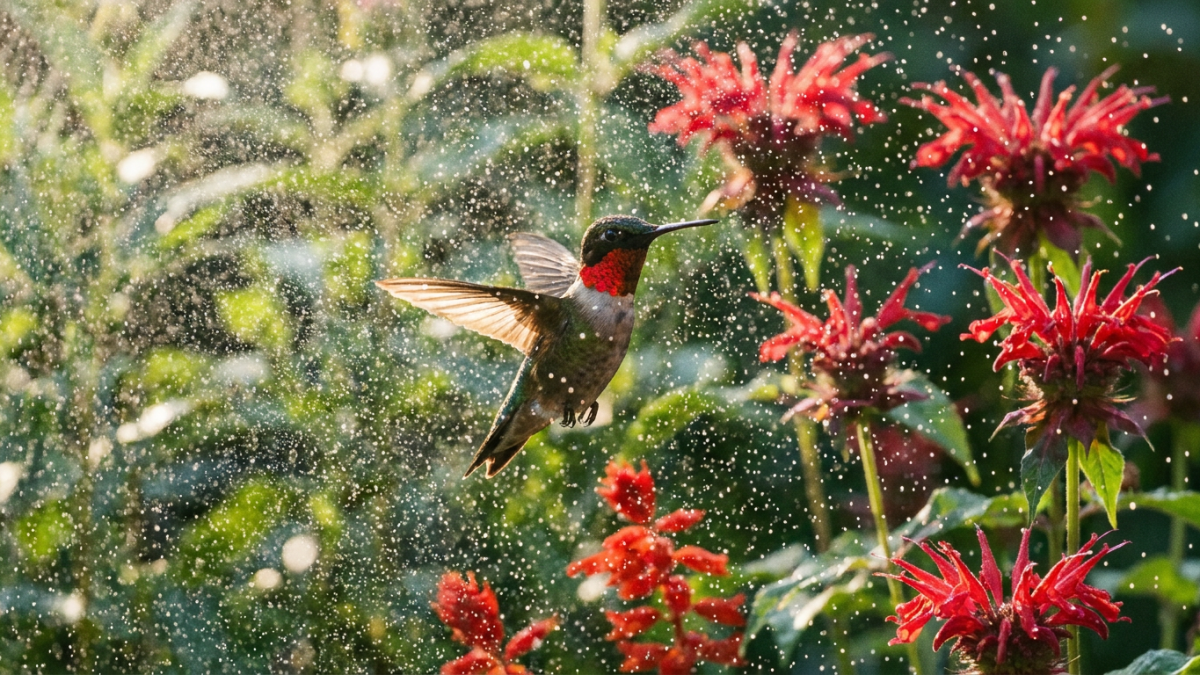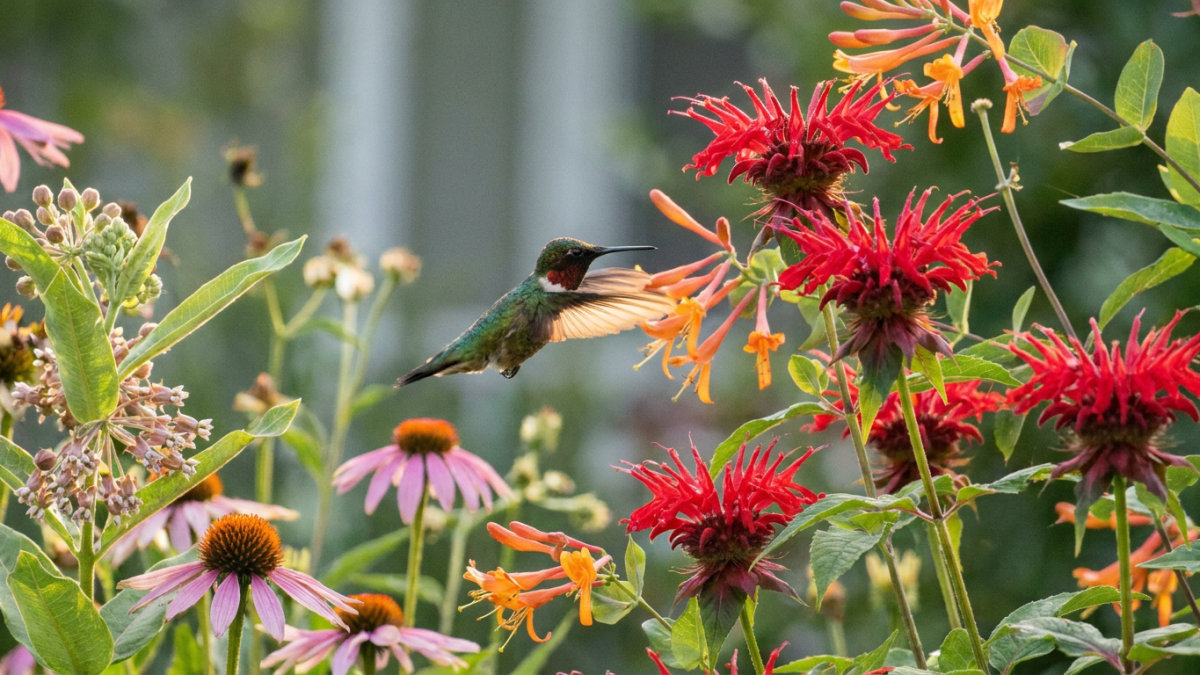
A hummingbird garden stays busy from arrival to departure when you stack five native tubular bloomers by season: eastern columbine in early spring, trumpet honeysuckle in mid-spring, scarlet beebalm and scarlet sage in summer, and cardinal flower from late summer into mid-fall. Each one is a red or orange tube shaped for a hummingbird bill.
The bloom windows below come from NC State Extension. Match them to your zone and you have nectar before the feeders go up and after the last frost warning.
The five natives and when each one blooms
| Plant | Bloom window | USDA zones | Sun |
|---|---|---|---|
| Eastern columbine (Aquilegia canadensis) | Early spring, flowers can last about a month | 3 to 8 | Part shade; tolerates more sun with enough moisture |
| Trumpet honeysuckle (Lonicera sempervirens) | Mid-spring, listed as spring into summer | 4 to 9 | Full sun for best flowering |
| Scarlet beebalm (Monarda didyma) | Summer, listed as summer into fall | 4 to 9 | Full sun, tolerates some shade |
| Scarlet sage (Salvia coccinea) | Early summer to first frost | 8 to 10 as a perennial, annual where winters freeze | Full sun to part shade |
| Cardinal flower (Lobelia cardinalis) | Late summer into mid-fall | 3 to 9 | Part shade to full sun; afternoon shade in hot climates, soil kept moist |
Source: NC State Extension Gardener Plant Toolbox, plants.ces.ncsu.edu, entries for each species.
Dates move with latitude, so read the table as an order of events rather than a calendar. In a cold zone, columbine and honeysuckle open later and overlap more.
Check when hummingbirds reach your area in our guide to when to put out hummingbird feeders, and plant so something is open by then.
Video: PlantDo Home & Garden
Early season: columbine and trumpet honeysuckle
NC State lists eastern columbine as a native perennial with red and yellow flowers that mature in early spring and attract hummingbirds, butterflies and bumblebees. It prefers organically rich, moist soil and partial shade.
Trumpet honeysuckle is a twining vine that reaches 10 to 20 feet and needs a trellis, arbor or fence. NC State says it flowers in mid-spring, that its flowers are not fragrant, and that hummingbirds are its pollinators. This is the native vine, not the invasive Japanese honeysuckle.
Summer: scarlet beebalm and scarlet sage
Scarlet beebalm grows up to 4 feet tall and spreads fast by underground stems, so give it room. NC State notes it likes moist, well-drained soil and full sun.
Scarlet sage blooms continuously from early summer to the first frost, and it is the pick for hot, drier beds. It overwinters only in zones 8 to 10, so treat it as an annual in the rest of the country.
Late season: cardinal flower
Cardinal flower carries the garden into fall. Its red spikes open from late summer into mid-fall, when migrating birds are fueling up. NC State says the soil should never dry out, so plant it by a downspout or a low spot.
Our migration timing guide explains why late bloom matters for the birds still passing through.
Pair the plants with a feeder and skip the sprays
Flowers do the heavy lifting, but a feeder fills gaps in bad weather. Keep a fresh batch of homemade hummingbird nectar out, and a mister gives the birds somewhere to bathe.
Leave pesticide off the beds. The birds feed directly from these flowers, so what you spray on them ends up on the birds.