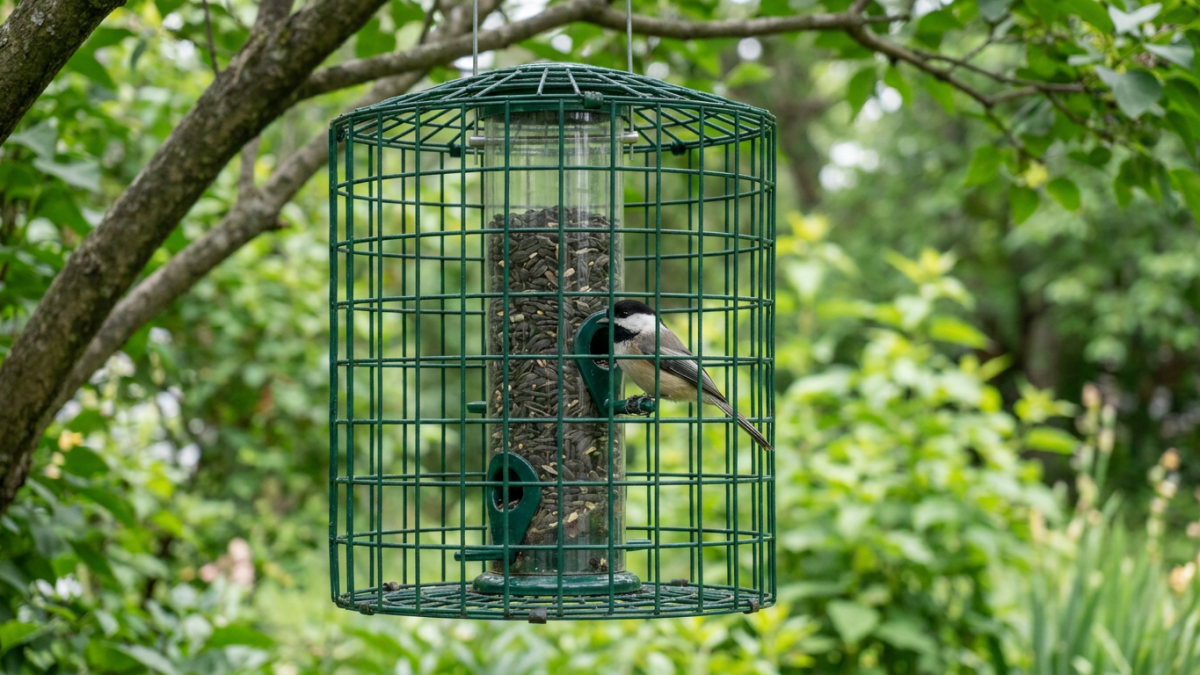
A bird feeder cage with 1.5 inch openings keeps out gray squirrels, European Starlings and Common Grackles, and it lets chickadees, finches, titmice and nuthatches feed inside. It also tends to lock out Northern Cardinals, and it does nothing against red squirrels or chipmunks.
So a cage solves one specific problem. Buy one when big birds and gray squirrels are emptying your tube feeder, and skip it when cardinals are the birds you want most.
How the 1.5 inch grid sorts your visitors
Wild Birds Unlimited (Barrie store) sells its tube feeder cages with a 1.5 by 1.5 inch mesh and says the openings exclude starlings, grackles and Eastern Gray Squirrels. Duncraft uses the same 1-1/2 inch fly-through openings on its Metal Selective feeder.
Small birds pass through the grid the way they slip through a dense shrub. Larger birds hit the wire and end up clinging to the outside.
Video: Badgerland Birding
| Species | Length (Cornell Lab) | Weight (Cornell Lab) | Behind 1.5 in mesh |
|---|---|---|---|
| Black-capped Chickadee | 4.7-5.9 in | 0.3-0.5 oz | Feeds inside (Duncraft) |
| House Finch | 5.1-5.5 in | 0.6-0.9 oz | Feeds inside (Birdseed & Binoculars) |
| Downy Woodpecker | 5.5-6.7 in | 0.7-1.0 oz | Learns to slip inside (Birdseed & Binoculars) |
| Northern Cardinal | 8.3-9.1 in | 1.5-1.7 oz | Usually blocked (Birdseed & Binoculars) |
| European Starling | 7.9-9.1 in | 2.1-3.4 oz | Blocked (WBU, Birdseed & Binoculars) |
| Common Grackle | 11.0-13.4 in | 2.6-5.0 oz | Blocked if the cage is 11 in wide or more (WBU) |
Notice the starling. It is no longer than a cardinal, yet the cage still stops it, because body bulk and wingspan matter more than length.
Where a cage fails
Diameter is the first trap. WBU warns that a cage narrower than about 11 inches lets grackles and starlings push their necks through the bars and reach the ports. Its own cages run 13 inches across.
Small mammals are the second. WBU states plainly that red squirrels and Eastern Chipmunks fit through 1.5 inch mesh, and they are too light to trip weight-activated feeders. If those are your raiders, a baffle on a pole works better, as covered in our guide on how to squirrel-proof a bird feeder.
Third, long-billed birds cheat. Birdseed & Binoculars reports Red-bellied Woodpeckers clinging to the outside and pulling sunflower chips out of the ports with their long beak and tongue.
The cardinal tradeoff
Cardinals like a tray or hopper perch, and the same blog found its caged feeders blocked them along with most other large birds. If you want both, run the cage for small birds and add an open tray or hopper with a safflower fill nearby for cardinals.
Comparing whole feeder designs rather than add-on cages? Our roundup of the best squirrel-proof bird feeders covers weight-activated and caged models side by side.
One more check after you install a cage: give birds time to learn it. If the feeder still sits untouched, work through the usual causes in why there are no birds at your feeder, from stale seed to poor placement.