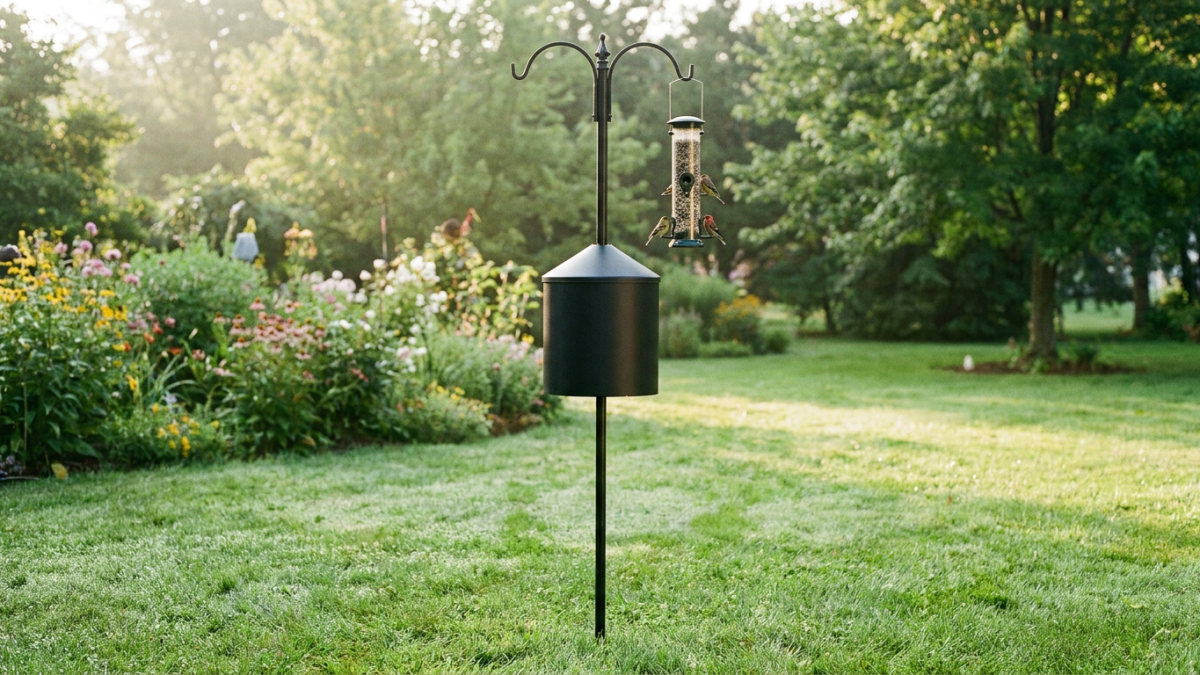
A bird feeder pole is only as squirrel-proof as its baffle and its placement. Buy a sturdy pole, mount a torpedo baffle so its top sits near 1.4 m off the ground, and keep the whole assembly at least 3 m from any branch, fence, or roofline a squirrel can launch from. Miss one of those and the rest is decoration.
Height and where the baffle goes
The pole needs enough height that the baffle sits above a squirrel’s standing leap, about 1.2 m, a figure extension services commonly cite. Below the baffle the pole should be smooth and straight: no brackets, no plant hangers, nothing climbable. Details are in how high a feeder should hang.
Placement beats hardware
A gray squirrel’s flat leap covers roughly 2.5 m, and they drop from above even farther, so distance is your cheapest defense. We cover the full checklist in squirrel-proofing a feeder, but the short version is to measure from the feeder to every launch point, not just the nearest tree. Decks defeat pole baffles entirely, because the mounting post is the house itself.
The failure cases worth knowing
Thin shepherd’s hooks are the first failure: a raccoon or a heavy gray squirrel tips them, or bends the hook until the feeder swings within jumping range. Deck mounts are the second; a pole baffle has nothing to attach to, so you are left with a dome baffle above the feeder or a weight-closing feeder instead. Our picks for poles and baffles note which baffles fit which mount types.
Ground mount or deck mount
Ground sleeves set in soil or concrete hold straight and let baffles work as designed. If you must mount on a deck rail, accept that the baffle game is limited and budget for a caged or weight-closing feeder as the real barrier.