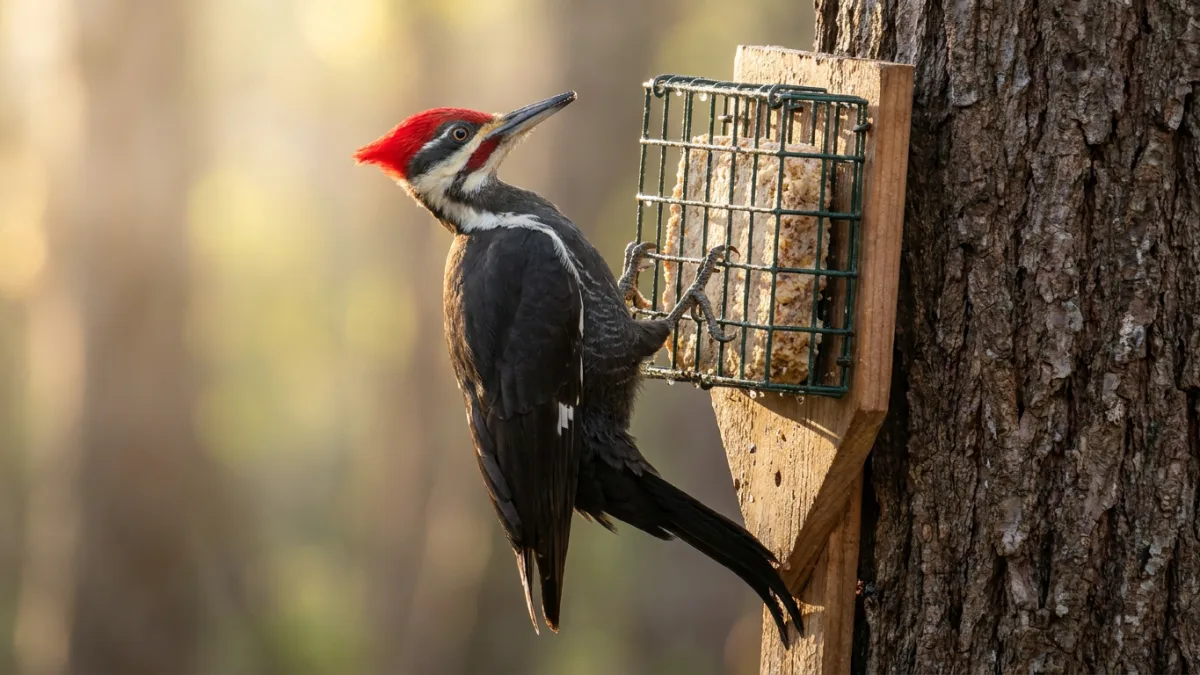
A pileated woodpecker will not use an ordinary suet cage, and the reason is body mechanics. At 15.8 to 19.3 inches long per Cornell Lab figures, this is a crow-sized bird that braces its tail against solid wood while it hammers. A standard cage gives a downy everything it needs and a pileated nothing to lean on, so the bird either ignores the feeder or works it apart.
The tail prop is the whole feature
A tail prop is a rigid extension below the cage that carries the bird’s weight the way a trunk does. Pileateds lean on it the moment they land, and once the prop runs long enough they settle in and empty a suet cake in a day. Cornell Lab’s own feeder cam footage from Ithaca shows a pair holding a prop-equipped feeder through a whole winter, which is the cleanest demonstration of the feature doing its job.
Prop length is not a detail to compromise on. Short props built for hairy woodpeckers leave a pileated’s tail hanging in air, and the bird gives up after a few awkward visits. If your target species is the big one, buy the feeder with the longest prop on the shelf.
Video: Cornell Lab Bird Cams
Cage size and build
Access openings need to be generous, since a pileated feeds with a chisel stroke rather than a pick. Vinyl-coated heavy wire survives the hammering far longer than thin hardware-store mesh, and a roof over the cake cuts rain damage dramatically. Our roundup of the best suet feeders flags which models carry real props, because plenty sold as woodpecker feeders are only downy-sized.
The starling problem
Here is the failure mode nobody prints on the box: everything that makes a feeder pileated-friendly also makes it starling-friendly. Open access, big cages, and solid props let a starling flock strip a cake in hours. The usual counter, an upside-down feeder, shuts starlings out reasonably well but defeats a tail-prop design too, since pileateds do not feed inverted. Most people end up accepting some loss and buying suet in bulk, or hanging a second, clinger-only feeder as a decoy.
Suet that survives weather
Plain suet cakes turn soft and rancid in warm rain. Rendered no-melt dough holds its shape well above freezing, costs a bit more, and is the only sane choice for a feeder a pileated will pound on through spring. If woodpeckers in general are the goal rather than this one species, start with our guide to attracting woodpeckers without losing your siding, since habitat beats hardware.
| Species | Body length (in) | What it needs at a suet feeder |
|---|---|---|
| Downy woodpecker | 5.5 to 6.7 | Any small cage, no prop needed |
| Hairy woodpecker | 7.1 to 10.2 | Standard cage, short prop a bonus |
| Red-bellied woodpecker | 9.4 | Medium cage, comfortable perch |
| Pileated woodpecker | 15.8 to 19.3 | Long tail prop, open access, heavy wire |
Lengths are Cornell Lab All About Birds figures. For telling the two lookalikes apart before you buy hardware, see our guide to downy vs hairy woodpeckers, since the size gap between them is exactly what feeder sizing gets wrong.