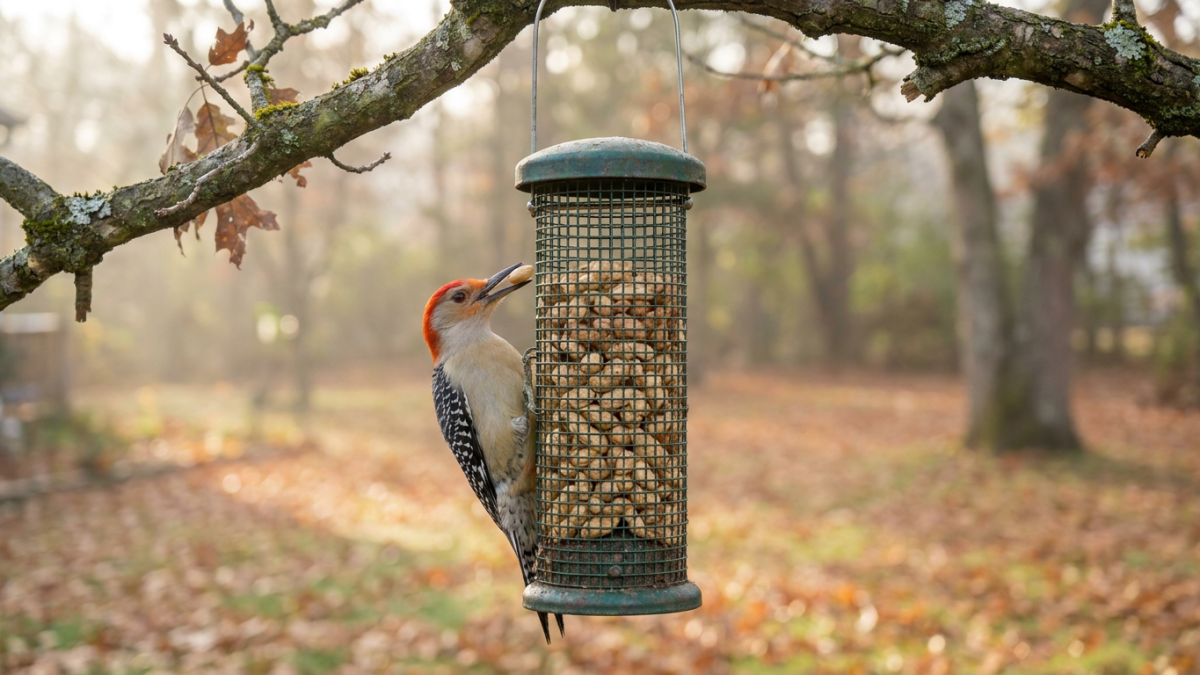
Shelled peanuts belong in a wire mesh tube, and in-shell peanuts belong on a tray or a wreath. Pick the feeder by the bird you want: a mesh tube feeds the clingers, meaning woodpeckers, nuthatches, chickadees and titmice, while a wreath or open tray feeds the jays that carry whole peanuts away.
That split is the whole decision. Finish, cap style and squirrel mechanism matter less than matching the peanut form to the opening.
Why peanuts pull in birds that ignore seed
Project FeederWatch at the Cornell Lab lists peanuts as high in energy and protein and names chickadees, titmice, nuthatches and jays as the birds most likely to take them. Woodpeckers are the other regulars: a bird that hangs on bark is comfortable hanging on wire.
FeederWatch also notes that jays grab several peanuts at a time and fly off to cache them, which is why a jay feeder empties fast.
Offer raw or roasted peanuts, never salted or coated ones, per FeederWatch. The same clinging birds use suet; our guide to suet feeders covers the cage styles that keep starlings off.
Video: Wild Birds Unlimited, Inc.
Mesh tubes for shelled peanuts
A mesh tube is a wire cylinder with a cap and a base. Birds cling to the outside and pull peanut pieces through the openings, so nothing clogs and no shells pile up below.
The Droll Yankees New Generation peanut feeder is the plain version: a 13 inch stainless wire tube, 2.5 inches across, holding 1 pound of shelled peanuts by the manufacturer figures. The Brome Squirrel Buster Nut adds a weight-triggered shroud that closes the mesh when a squirrel lands, holds 1.3 pounds, and ships with two interchangeable meshes for peanut halves or larger nuts and suet nuggets.
Wild Birds Unlimited sells its Quick-Clean mesh peanut tube in 9.75 inch and 14 inch lengths with a removable bottom for scrubbing; the smaller one holds 1.18 pounds per the store spec sheet.
Trays and wreaths for in-shell peanuts
Whole peanuts do not fit through mesh, so they go on a platform tray or into a coiled wire wreath. The Wild Birds Unlimited Peanut Wreath is a spiral ring in 12 inch and 18 inch diameters; jays pull a peanut from between the coils, and woodpeckers hang on and peck the shell open in place.
Squirrels and chipmunks eat in-shell peanuts too, so hang the wreath on a baffled pole or accept that you are feeding the whole yard. Our blue jay guide covers tray placement for the birds that come to peanuts first.
Feeder specs side by side
| Feeder | Peanut form | Capacity (maker figure) | Size (maker figure) | Squirrel defense | Street price |
|---|---|---|---|---|---|
| Droll Yankees New Generation Peanut Feeder (CJM13GP) | Shelled | 1 lb | 13 in tall, 2.5 in diameter | None | $35.99 listed at Ace Hardware |
| Brome Squirrel Buster Nut | Shelled, nuts, suet nuggets | 1.3 lb | Not published on the product page | Weight-activated shroud, chew-proof parts | $98.95 at the Brome store |
| Wild Birds Unlimited Quick-Clean Mesh Peanut, small | Shelled | 1.18 lb | 9.75 in tube, 2.75 in diameter | Optional cage | In-store pricing only |
| Wild Birds Unlimited Quick-Clean Mesh Peanut, large | Shelled | Not published | 14 in tube, 3 in diameter | Optional cage | In-store pricing only |
| Wild Birds Unlimited Peanut Wreath | In-shell | Not published | 12 in or 18 in diameter ring | None | In-store pricing only |
Sources: Brome store, BFG Supply and Ace Hardware listings for the Droll Yankees CJM13GP, Wild Birds Unlimited Barrie product pages. Street prices on the date of writing.
Keeping peanuts safe to eat
Peanuts mold. FeederWatch says to discard shelled peanuts at the first sign of mold and to wash seed feeders every week or two with warm water and dish soap, more often in wet weather.
A mesh tube dries fast after rain. A wreath or tray that holds wet shells needs a rake underneath and a shorter refill cycle.
If woodpeckers are the target and you worry about your siding, our woodpecker article explains what drumming on a house actually means.