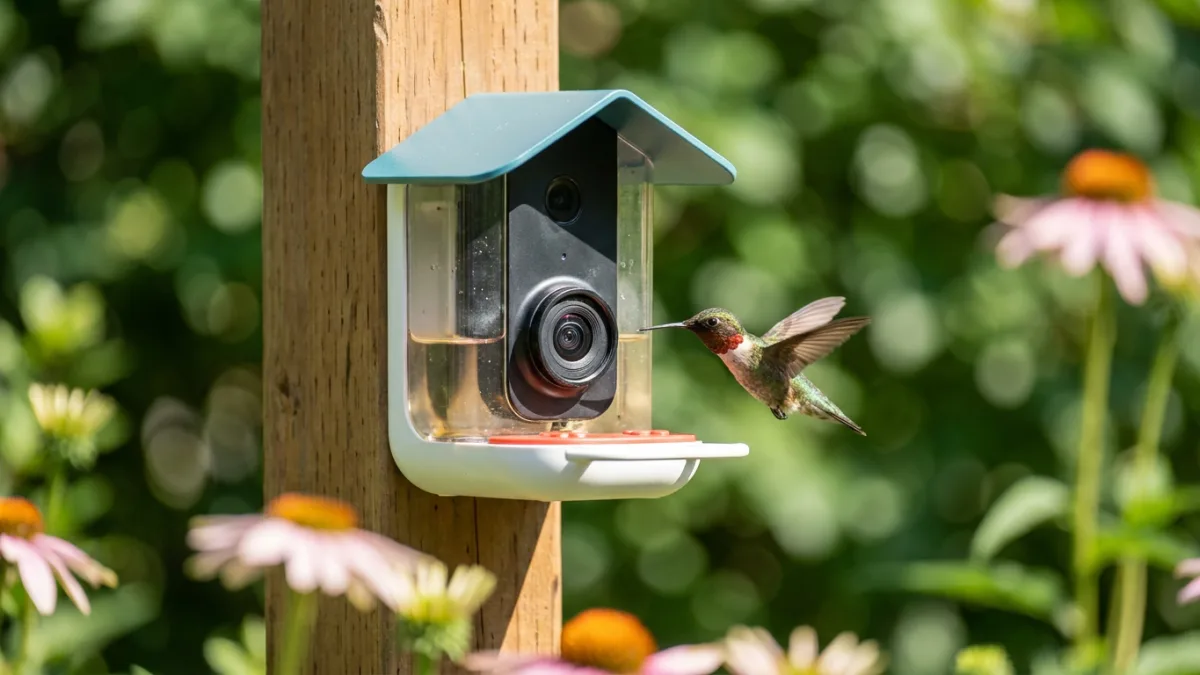
Most hummingbird camera feeder blur has nothing to do with resolution. It is focus distance. A hummingbird feeds with its head a few centimeters from the camera module, while generic feeder cameras inherit wide lenses focused from about arm’s length outward. The bird arrives, the clip records, and the head is a soft smear while the fence behind it is sharp.
What close focus means on the spec sheet
Camera listings include a minimum focus distance. Lenses built for nest boxes or backyard surveillance focus from roughly a meter and beyond, which suits slow subjects at a distance. A hummingbird at a nectar port sits far closer than that, so you need a lens with a stated close-focus or macro rating. If a listing does not mention one, assume it does not have it.
The specs worth paying for
- A stated close-focus or macro distance, not just a megapixel count.
- A wide field of view, since hummingbirds approach ports from the sides rather than head-on.
- A removable camera module. Nectar is sticky and the feeder needs scrubbing every few days in summer heat, and sealed-in electronics turn that routine into a mold risk.
What the Bird Buddy version gets right and wrong
The Bird Buddy hummingbird feeder camera is the most common first purchase, and its mixed reviews track straight to focus. Distant perched birds and feeder shots look great; beak detail at the port depends on where the bird lands. Before blaming the app, check whether the whole frame is soft or only the near bird. A sharp feeder with a blurry hummingbird means the lens simply cannot focus that close.
Cleaning is the hidden cost
Every camera feeder fails as a feeder first. The module adds seams and crevices to a vessel that must come apart for scrubbing on the same schedule as any hummingbird feeder cleaning routine, every couple of days in warm weather. If disassembling electronics twice a week does not appeal, a plain feeder from the best hummingbird feeders list plus a separate trail camera often yields cleaner footage for less money. That pairing fails the other way: the trail camera has the focus range the integrated units lack, but you lose the automatic species clips that made the category interesting.