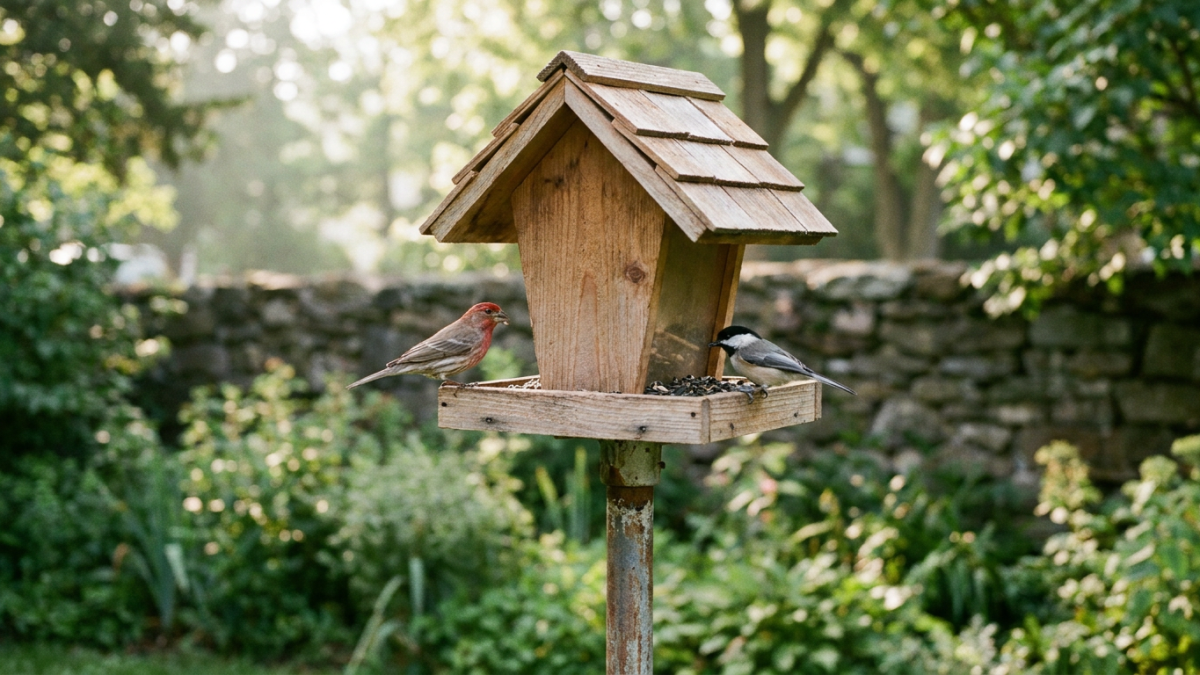
The bird feeder plans worth building share three traits: a floor that drains, a roof that sheds rain away from the seed, and a body you can take apart for cleaning. Plans that skip any of those produce feeders that look great on day one and grow mold by week three.
Judge a plan by how it handles water and cleaning, not by how the finished photo looks.
Three Free Plans Compared on Drainage and Access
Most roundups link out to PDFs without reading them. Here is what three widely shared plans actually specify, taken from each publisher’s own page.
| Plan | Feeder type | Stock called for | Key figures | Drainage and cleaning |
|---|---|---|---|---|
| Lowe’s Bird Watch feeder | Hopper on a post | 1 x 2 in cedar, polycarbonate sheet, 1/2 in x 6 ft galvanized pipe | Seed gap 1/4 in under the clear front and back | Slatted base spaced with brad nails; roof slides up to fill; clear panels unscrew |
| 30 Minute Woodshop platform feeder | Covered platform | One 6 ft western red cedar fence picket | Floor 8 x 10 in; roof panels 13 x 7 in and 13 x 7-5/8 in; 5/8 in rails | Solid glued floor, no drain holes specified; roof and sides are glued and nailed |
| MyHow2 Classic bird feeder | Classic hopper | 3/4 in board, 6-1/4 in wide (1.8 x 16 cm) | Cut list sold as a PDF for $2.00 on the publisher’s page | Video is free to watch; full cut list is paid |
Figures come from the plan publishers. None of these plans lists a finished capacity, so treat any capacity claim you see elsewhere with suspicion.
Video: Backyard Biology Boys
Which Design to Build First
Build the Lowe’s hopper if you want one feeder that serves most backyard species. The slatted base lets water drop through, and the removable clear panels are the part you will thank yourself for at cleaning time.
Build the platform if you want ground feeders like juncos and doves. Before you glue the floor, drill a grid of small holes or swap the solid panel for wire mesh. A solid tray holds rain, and wet seed turns sour fast.
If you are torn between the two shapes, our breakdown of platform feeders versus tube feeders covers which birds use each one.
Designs Worth Skipping
Skip any plan with a fully enclosed, glued-shut seed box. You cannot scrub what you cannot open.
Skip decorative log-cabin and lighthouse builds with tiny perches and narrow seed slots. They photograph well, but the openings jam with hulls and the corners trap damp seed.
Skip homemade tube designs made from soda bottles if the ports are not sized to the seed. Our guide to tube feeder ports and seed match explains why the wrong port size wastes most of the mix.
Build for the Cleaning You Will Actually Do
Cornell Lab’s Project FeederWatch advises cleaning feeders about once every two weeks, more often in wet weather or heavy use. It recommends a dilute bleach solution of no more than 1 part bleach to 9 parts water, a thorough rinse, and full drying before you refill.
That routine shapes the build. Use screws instead of glue on at least one wall or the roof, so the feeder comes apart in a minute.
Leave the parts that touch seed unstained, as the Lowe’s plan instructs, and choose cedar for its rot resistance.
Mounting Finishes the Plan
A well-built feeder on a bare post is a squirrel buffet. The Lowe’s plan mounts on a threaded pipe for exactly this reason, and it leaves room to add a baffle below the platform.
Pick the pole and baffle before you cut wood, because the flange size sets the base dimensions. Our roundup of the best bird feeder poles and baffles covers mounts that fit a homemade base.