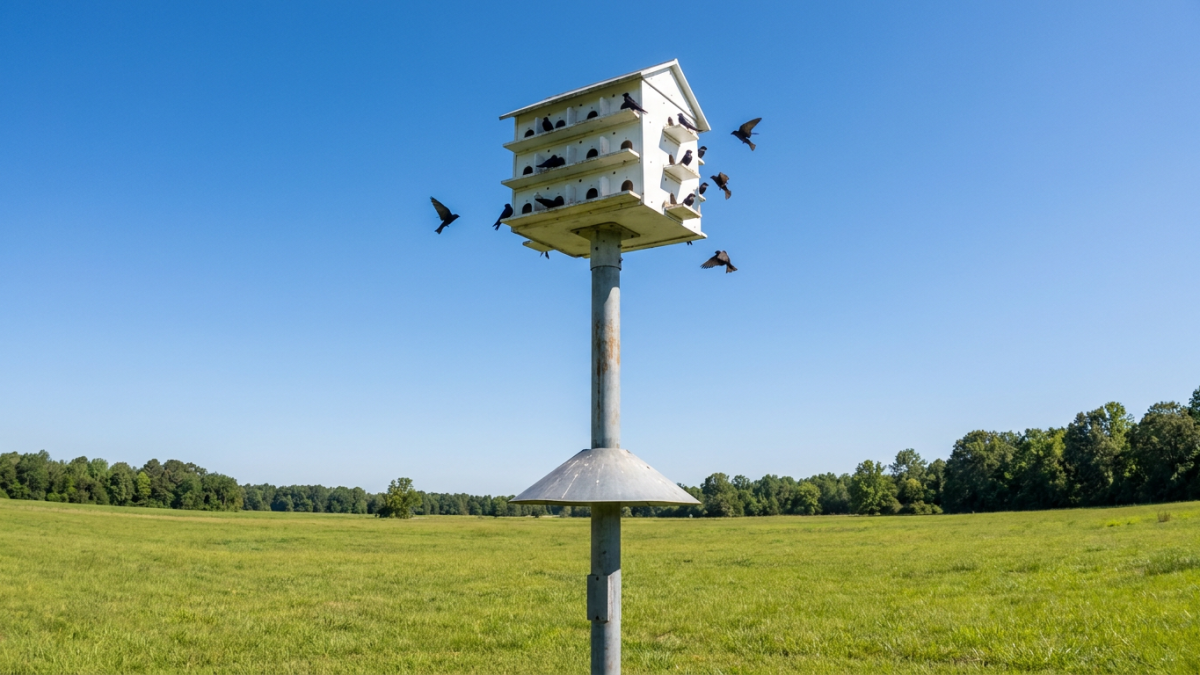
A purple martin house with pole only works if the site passes four checks first: open flight space, a pole that raises and lowers the house, a height of 12 to 20 feet, and a pole guard from day one. Miss one and the house price barely matters.
Every figure below comes from the Purple Martin Conservation Association (PMCA).
Start With the Site, Not the Product
Martins pick housing by the space around it. PMCA’s housing standards put the house at least 40 feet, and preferably 60 feet, from trees or buildings, and within 100 feet of human activity.
That second number surprises people. PMCA links human activity with protection from predators, so the middle of the lawn beats the back corner of the lot.
Walk your yard with a tape measure first. If no spot clears 40 feet from every tree, a pricier house will not fix it. In the southern range martins may accept 25 feet, PMCA notes, but open ground is still preferred.
Video: Donna Hardy
The Pole Has to Move Up and Down
This is the requirement most product bundles bury. PMCA says martin housing should raise and lower vertically on a telescoping pole, lanyard or winch system.
You will lower it often, sometimes daily, to pull House Sparrow and European Starling nests and check martin nests. A fixed pole and a ladder make that a chore you will quit by June.
PMCA recommends 12 to 20 feet, noting that higher housing takes more wind damage. Set the pole in concrete 18 to 25 inches deep, or use a manufacturer ground socket so you can move it later.
Guards Go On Before the Birds Arrive
PMCA’s rule is blunt: predator guards on all active housing. Snakes, raccoons and squirrels climb any pole, wood or metal.
The top of the pole guard should sit at least 4 feet above the ground. Mount it lower and a large raccoon or snake can reach past it.
Hawks, owls and crows reach into shallow rooms, so PMCA also advises an external owl guard on every house. A removable cage of 2 x 4 inch hardware cloth is the homemade version.
Check the House Specs Against the Pole
Once the site and pole pass, judge the house itself.
If you are comparing plans or kits, our guide to bird house plans and dimensions shows how compartment size changes by species. For martins, bird house hole size matters more than usual, because the starling-resistant crescent entrance is not round.
Look for access doors on every room and a white exterior, which PMCA favors because it reflects heat. More on that in our piece on function-first bird house designs.
| Requirement | PMCA figure | What it means for your setup |
|---|---|---|
| Distance from trees or buildings | At least 40 ft, preferably 60 ft | Measure before buying |
| Distance from human housing | Within 100 ft (housing standards); 30 to 120 ft (location guide) | Mid-lawn beats a back corner |
| Housing height | 12 to 20 ft | Taller means more wind stress |
| Pole depth in concrete | 18 to 25 in below ground | Or a manufacturer ground socket |
| Pole guard top | At least 4 ft above ground | Install before opening the house |
| Round entrance hole | 2-1/8 in typical; 1-3/4 to 2-1/4 in acceptable | About 1 to 1-1/2 in above the floor |
| Crescent entrance | 3 in wide, 1-3/16 in tall | Starling-resistant option |
| Compartment size | 6 x 6 in minimum; 7 x 12 in preferred | Deeper rooms keep nestlings out of predator reach |
Source: PMCA Standards for Purple Martin Housing and PMCA Housing Location page.
A First-Season Readiness Check
- Open spot at least 40 feet from trees, close to the house you live in
- Telescoping, winch or lanyard pole rated for your house’s weight
- Pole guard mounted with its top 4 feet or more above ground
- Owl guard or hardware-cloth cage on the house
- Door plugs to keep other birds out until martins return
- A routine for lowering the house to check nests through the season
Tick all six and your setup meets what PMCA asks of new martin landlords.