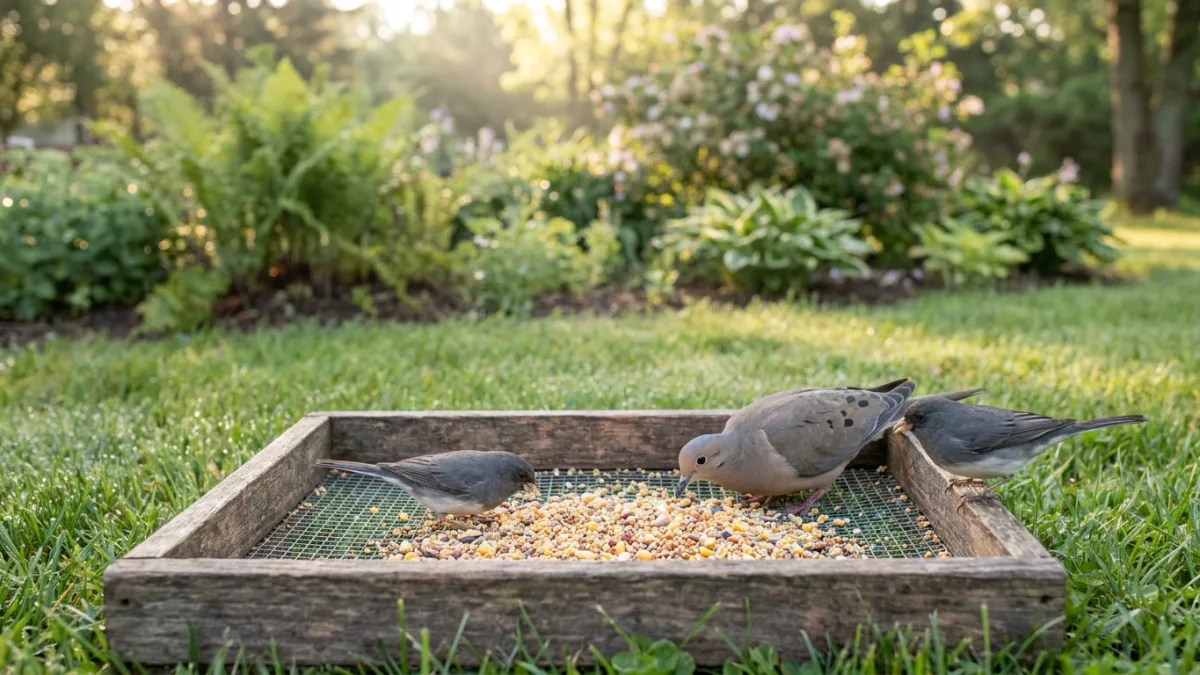
A ground bird feeder is a low tray with a mesh floor, and it feeds the birds that rarely land on anything hanging: doves, juncos, native sparrows, towhees and cardinals. Put millet, cracked corn or black oil sunflower on it, raise it a few inches off the soil, and rake under it every few days.
Who actually eats on the ground
Project FeederWatch at the Cornell Lab says sparrows and doves prefer large flat surfaces and may never visit an elevated feeder. Song Sparrows, Fox Sparrows and towhees rarely land on a feeder at all, but they readily take fallen seed from the ground beneath one.
All About Birds tags both the Northern Cardinal and the Dark-eyed Junco as ground foragers. Cardinals forage on or near the ground, often alongside juncos and White-throated Sparrows.
A tray near the ground pulls in the species a tube feeder skips. The platform feeder vs tube feeder comparison covers that tradeoff.
Video: Countryside Flower Shop, Nursery and Garden Center
What to put out, and what to skip
FeederWatch recommends mixing cracked corn with millet and feeding a scoopful on the ground or a platform for doves, quail and sparrows. A handful of millet alone keeps juncos and sparrows busy. Black oil sunflower draws cardinals and most other seed eaters.
Skip mixes heavy in milo. FeederWatch notes it is not a favorite of most eastern birds and tends to go to waste, which on a ground tray means a pile of uneaten grain going soft in the rain.
The same open tray that feeds sparrows also feeds grackles, starlings and pigeons. FeederWatch’s advice for people who want fewer of those: avoid platform trays and do not spread food on the ground. A ground feeder is a trade you make on purpose.
Ground trays worth comparing
Every tray below has a mesh or perforated floor, since All About Birds recommends a screened bottom for drainage. Dimensions are manufacturer figures; prices are street prices on the date checked.
| Feeder | Dimensions | Mesh floor | Cover | Street price (retailer) |
|---|---|---|---|---|
| Woodlink 3-in-1 Platform (PLAT2) | 16.5 x 13.25 x 2.5 in, fold-out legs | Yes, slide-out screen | No | $55.99 (Wild Bird Store Online) |
| Wild Birds Unlimited EcoTough Covered Ground Tray | 18.25 x 16.5 x 9.5 in; tray 13.25 x 8 in | Yes, lift-out perforated metal | Yes, roof | In store only (Wild Birds Unlimited) |
| Wild Birds Unlimited Catch-a-Seed Tray with Platform Leg Kit | 20 x 16 x 2.75 in | Yes, lift-out perforated metal | No; optional 2 in mesh cage | In store only (Wild Birds Unlimited) |
| Duncraft Eco-Strong Ground Platform (3009) | 13.25 x 13.25 x 5 in; holds 2 lb | Yes, metal mesh | No | $69.95 (Duncraft) |
| Duncraft Open Air Ground Platform (4781) | 17 x 11.25 x 7 in | Yes, metal mesh | No | $69.95 (Duncraft) |
| Duncraft Protected Ground Platform (Q4730) | 20 x 16 x 18 in | Yes, metal mesh | Yes, angled roof | $199.95 (Duncraft) |
Covered trays cost more and keep seed dry through a shower. Open trays are cheaper and easier to rake around. The bird feeder trays guide covers the catch-tray versions that bolt under a pole feeder.
Keeping a ground feeder clean
Hygiene is where ground feeding goes wrong. FeederWatch asks you to clean seed feeders every week or two, more often in wet weather, and to rake or sweep under feeders regularly so droppings and spoiled food do not build up. Rotating the feeder between spots spreads the mess.
Wet seed is the specific risk. A FeederWatch research note on Trichomonas gallinae, a parasite of doves and finches, found it persisted only in wet seed, for up to 48 hours in warm conditions, and never in dry seed. Bring the tray in before heavy rain when it is hot, and swap seed out often in hot, wet weather.
Fill for a couple of days at a time, not a week, then lift the mesh and hose it before refilling. Rake the hulls while the tray is out. Our schedule for how often to clean a bird feeder applies to trays as much as tubes.
Keep cats inside too. FeederWatch singles out ground-feeding birds as the ones at greatest risk from outdoor cats, and a tray on the lawn is the easiest ambush in the yard.