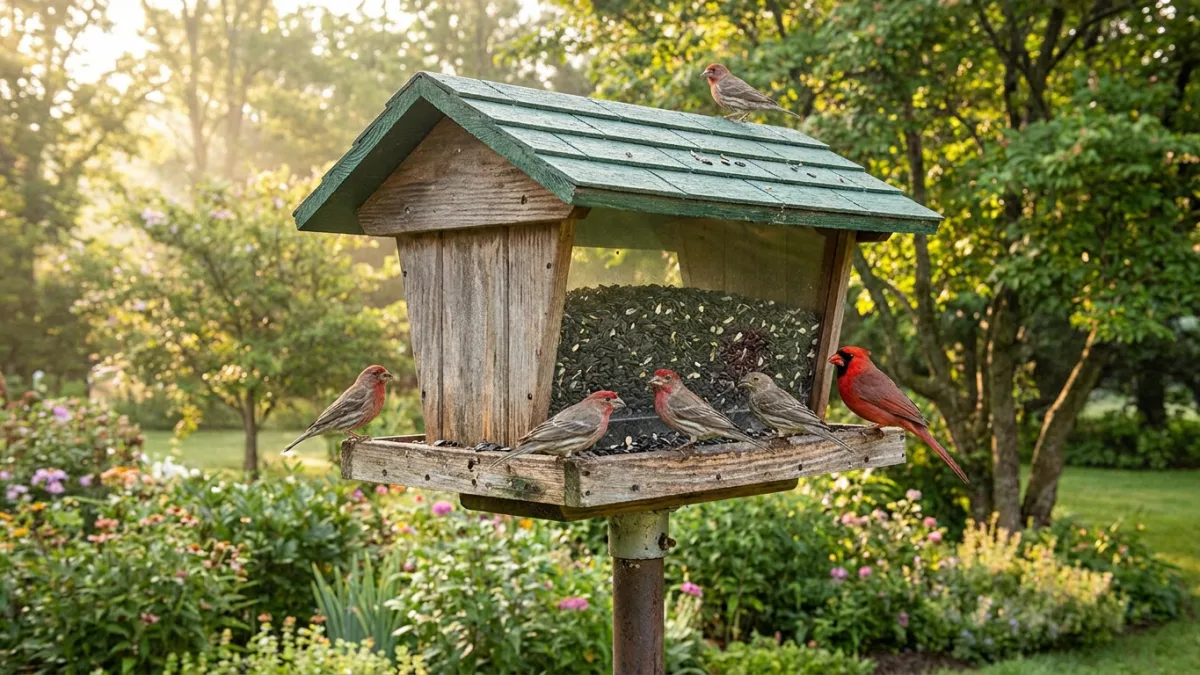
A large bird feeder makes sense when your birds empty a standard feeder in a day or two and you cannot refill that often. Size it to about two weeks of seed for your yard. Past that point the extra capacity mostly holds seed you will throw out at the next cleaning.
Capacity is the easy part to buy. The harder parts are the weight on your hanger, how long seed sits before birds eat it, and how many squirrels the bigger target draws.
How big feeders compare on capacity and ports
The figures below are manufacturer figures from the Duncraft product pages, with Duncraft’s listed price at the time of writing. Capacity in pounds assumes black oil sunflower or mixed seed. Lighter seed fills the same volume at a lower weight.
| Feeder | Type | Capacity | Feeding access | Size | Price (Duncraft) |
|---|---|---|---|---|---|
| Brome Squirrel Buster Plus | Tube | 5 lb | 6 ports | 28 in tall | $129.95 |
| Duncraft 4-Sided Free-Flowing Hopper | Hopper | 7 lb | Tray on 4 sides | 16 x 11-5/8 x 11-1/2 in | $149.95 |
| Going Green Tall Hopper | Hopper, pole mount | 9 lb | Tray on 4 sides | 11-1/2 x 12-1/2 x 13-1/2 in | $149.95 |
| Jumbo Squirrel Resistant Hopper | Caged hopper | 9-3/4 lb | 4 ports plus tray | 7 x 11 x 17 in | $89.95 |
| Feeding Frenzy | Domed reservoir | 12 lb | 8 ports | 13 in tall, 15-3/8 in dome | $99.95 |
| Squirrel-Proof Heavy-Duty Caged | Caged tube | 18 lb | 6 ports | 12-1/2 in wide, 26-1/2 in tall | $179.95 |
Video: Ace Hardware
Working out your own refill interval
No published figure tells you how fast your yard eats seed, because it depends on your flock, the season and the seed. So measure it. Note how many days your current feeder takes to empty and divide its capacity by that number.
Say a 2 lb tube empties every two days. That is about 1 lb a day, so the 9 lb Going Green hopper would last roughly nine days and the 18 lb caged feeder roughly eighteen. Treat that as an estimate. Winter cold and a passing flock of grackles can double the rate overnight.
Then compare the result with your cleaning schedule. Project FeederWatch at the Cornell Lab advises cleaning feeders every week or two. A feeder that still holds seed on cleaning day gets emptied anyway.
The trade-offs of a big hopper
Seed that sits longer has more time to get wet. A 2017 study in Avian Diseases, summarized by Project FeederWatch, found that Trichomonas gallinae, a parasite that harms finches, doves and pigeons, persisted only in wet seed, for up to 48 hours at 98 F, and not at all in dry seed. A roof or dome matters more on a feeder you fill once a fortnight. Keep spare seed sealed too, as covered in how to store bird seed fresh.
Weight adds up fast. Eighteen pounds of seed plus a steel cage is more than many clamp-on hooks carry, so check the rating on your hanger against the filled weight. The heaviest feeders belong on a sunk pole. Our bird feeder pole setup guide covers depth and baffle height.
A full hopper also draws squirrels for longer. That is why three of the six feeders above use a cage or a weight-sensitive perch.
Tube or hopper at large sizes
Large tubes keep seed sealed until a bird pulls it from a port, so less of it gets rained on. Large hoppers feed cardinals and other birds that like a flat ledge, but the seed tray is exposed. If you are torn between the two styles, the tube feeder vs hopper feeder comparison breaks down which birds each one serves.
Pick the smallest feeder that covers your real refill gap. Size up only if you know your yard can empty it before cleaning day.