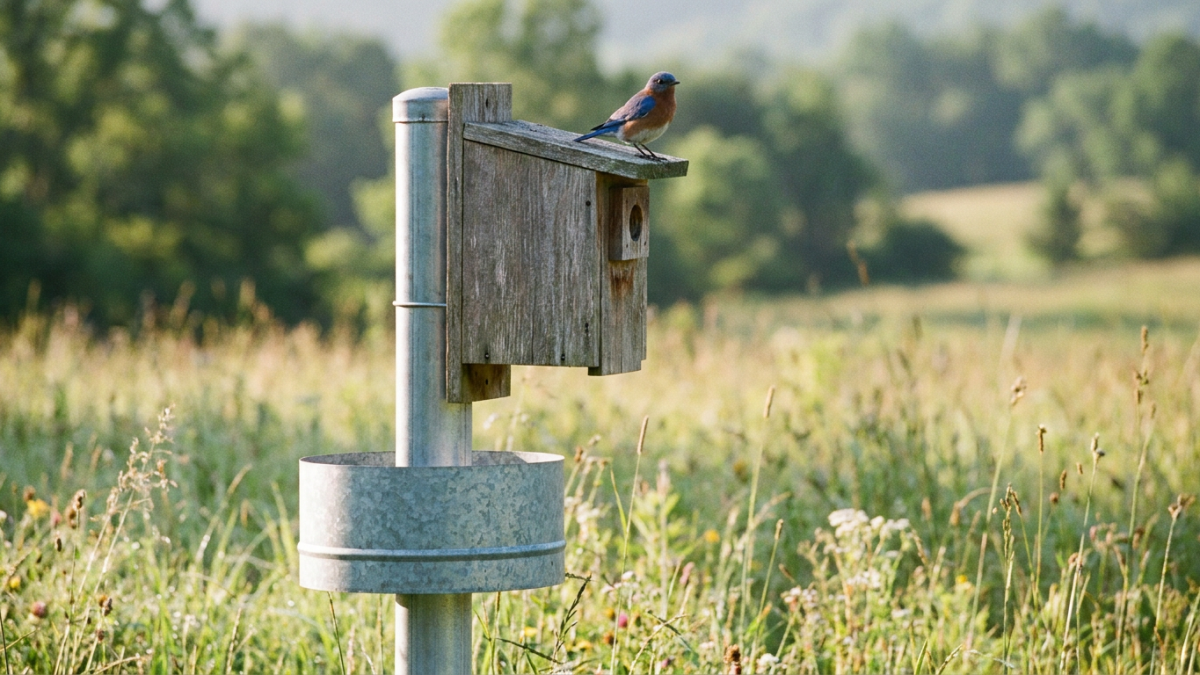
Mount a bluebird house on a smooth metal pole with the entrance hole about 5 feet off the ground, facing open habitat, and slide an 8-inch stovepipe baffle onto the pole below the box. That setup settles the two things that decide a season: whether bluebirds pick the box, and whether a snake or raccoon reaches the eggs first.
How high a bluebird house pole should put the box
Cornell Lab’s NestWatch lists a height range of 4 to 6 feet from the ground for Eastern Bluebird boxes. The North American Bluebird Society (NABS) is a little stricter and asks for the entrance hole to sit at least 5 feet up.
Go with the NABS figure. You can still open the door and check the nest without a ladder.
Face the entrance east and toward open ground, as NestWatch advises. Bluebirds hunt insects from perches over short grass, so a box at a lawn edge or meadow beats one tucked against shrubs. Our guide on how to attract bluebirds covers the habitat side.
Video: BirdWatchersDigest
Pick the pole before the guard
NABS recommends a smooth, sturdy support: 1/2 to 3/4 inch electrical metal conduit (EMT), or a steel T-post topped with 1.5 inch EMT. Smooth metal gives climbing predators almost nothing to grip. NABS also advises against fence lines and trees, which work like ladders for raccoons and snakes.
Keep the pole clear of branches, shrubs, and roof edges. The Tennessee Wildlife Resources Agency (TWRA) notes that any guard fails if a predator can jump to the box from nearby cover.
Attachment is the easy part. NABS lists screws, pipe hangers, wire, or U-bolts, and any of them will hold a box built to our bluebird house plans.
Stovepipe baffle or cone: where the guard goes
TWRA calls a 24-inch long, 8-inch diameter stovepipe the most effective guard against snakes, raccoons, cats, and squirrels. The top of the baffle should sit at least 4 feet off the ground, and it should wobble slightly on its bracket so nothing can climb over the rim.
A cone baffle works too, and it suits a wooden post better. In a NestWatch analysis of 24,114 nest records, cone baffles, stovepipe baffles, and entrance hole extenders performed about equally well, while the Noel guard (a wire cage around the hole) trailed behind.
That study, published by Bailey and Bonter in 2017, found a 6.7% gain in nest success for guarded boxes across all species. Boxes with two guards, such as a baffle plus a hole extender, did better on average. Western Bluebirds were the exception, with no clear benefit from a guard.
Setup figures at a glance
| Setup detail | Recommended figure | Source |
|---|---|---|
| Box height from ground | 4 to 6 ft | Cornell Lab NestWatch |
| Entrance hole height | At least 5 ft | North American Bluebird Society |
| Box facing | East, toward open habitat | Cornell Lab NestWatch |
| Pole | 1/2 to 3/4 in EMT conduit, or T-post topped with 1.5 in EMT | North American Bluebird Society |
| Stovepipe baffle size | 8 in diameter x 24 in long | Tennessee Wildlife Resources Agency |
| Baffle top height | At least 4 ft off the ground | Tennessee Wildlife Resources Agency |
| Spacing between boxes | 300 ft | Cornell Lab NestWatch |
| Nest success gain with a guard | 6.7% (all species combined) | Bailey and Bonter 2017, NestWatch data |
Small checks that save a brood
Match the entrance to the bird. NABS accepts a 1 1/2 inch round hole for Eastern Bluebirds, and our bird house hole size chart covers the other species.
- Space boxes about 300 feet apart, or pair two boxes 15 to 20 feet apart where Tree Swallows compete.
- If you have no baffle yet, TWRA mentions lithium-based grease on a bare metal pole as a stopgap.
- Clean out the old nest right after the young fledge so the pair can start a second brood.
- Each spring, check that the baffle still wobbles and has not slid down the pole.