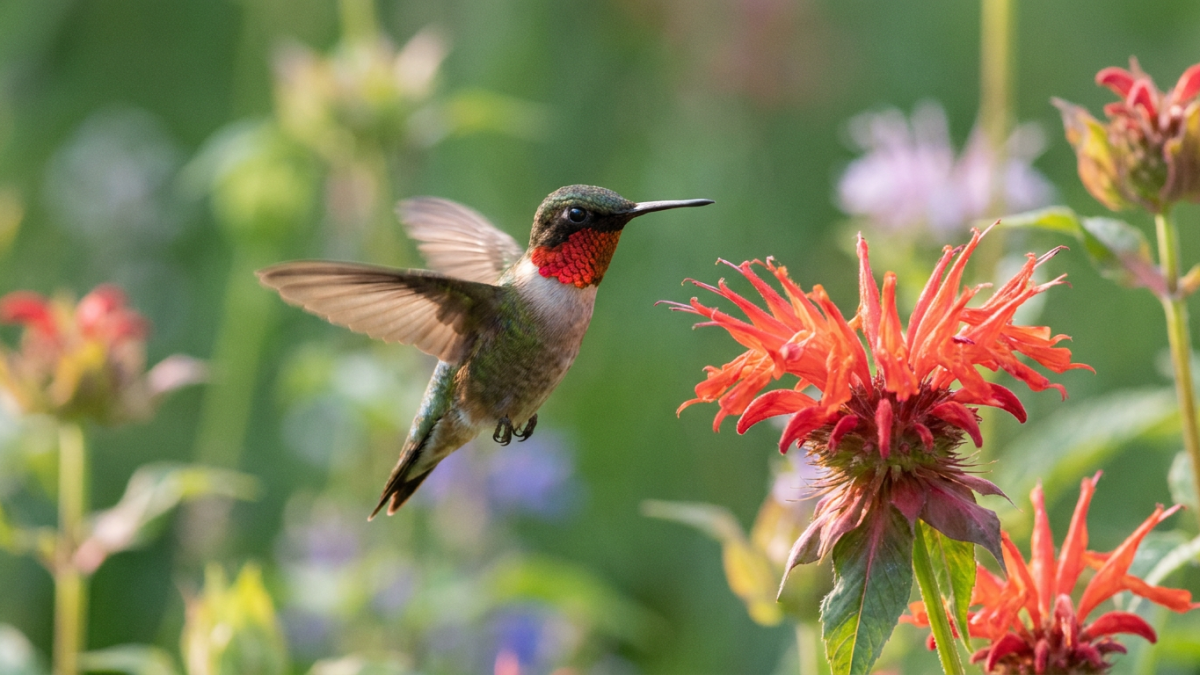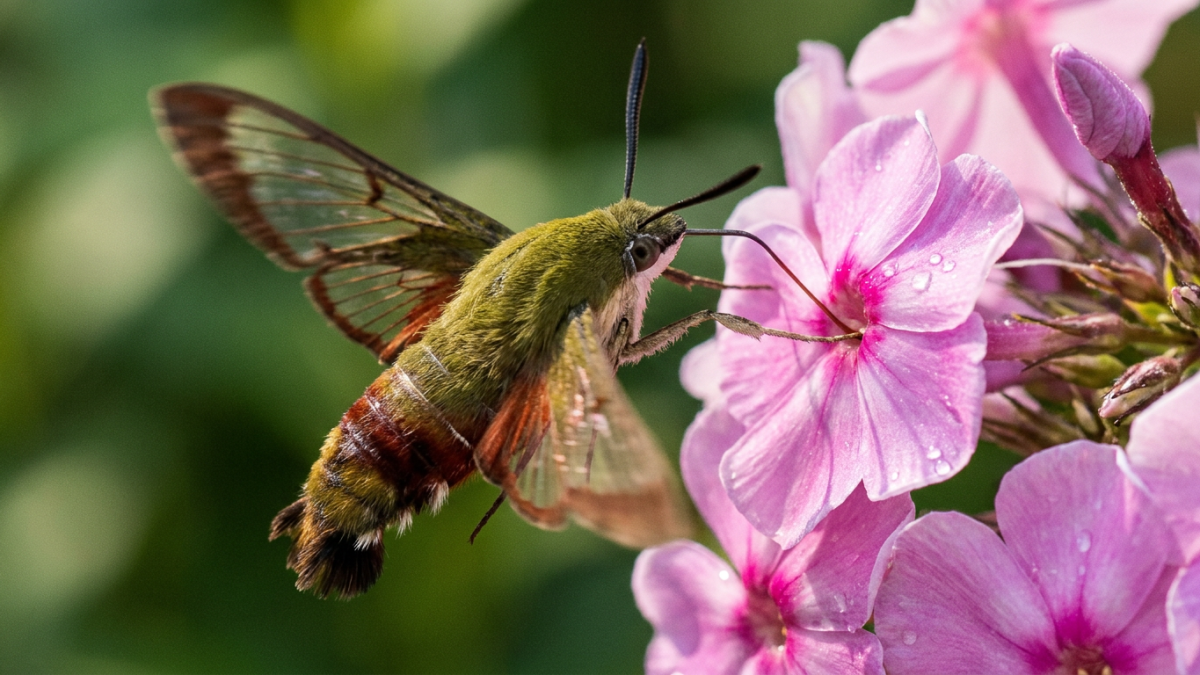
The insect that looks like a hummingbird is a hummingbird moth, most often the hummingbird clearwing (Hemaris thysbe) or the snowberry clearwing (Hemaris diffinis). Both are day-flying sphinx moths that hover at flowers and sip nectar through a long proboscis.
The quickest check is size: Mass Audubon puts a ruby-throated hummingbird at about 3 inches long and a hummingbird moth at about 1.5 inches. Below you get the species, the table that separates them, and the features that give the moth away.
Which moths get mistaken for hummingbirds
Three North American moths cause nearly all the double takes. Audubon magazine names the hummingbird clearwing as the most common, then the snowberry, slender and Rocky Mountain clearwings, plus the white-lined sphinx.
The clearwings have mostly transparent wings with a dark border, which is unusual in moths. The white-lined sphinx is bigger, with pink flashing in the hindwings, and flies mostly at dusk.
The Wisconsin Horticulture extension describes the hummingbird clearwing as fairly common across the eastern half of the U.S. and Canada, with a furry olive or tan body and a wide reddish-brown band across the abdomen.
Video: Papa Ray’s Adventure Channel
Hummingbird moth species side by side
| Moth | Wingspan | Telltale feature | When it flies | Caterpillar host plants |
|---|---|---|---|---|
| Hummingbird clearwing (Hemaris thysbe) | 1.75 to 2.25 in (Missouri Dept. of Conservation) | Pale legs, olive back, ragged edge between clear and dark wing areas | Daytime | Viburnum and related plants (Wisconsin extension); dogbane, snowberry, honeysuckle (NC State) |
| Snowberry clearwing (Hemaris diffinis) | 1.25 to 1.75 in (Missouri Dept. of Conservation) | Bumblebee look, black legs, black band through the eye | Daytime, sometimes into evening | Coralberry, snowberry, honeysuckles, dogbanes (Missouri Dept. of Conservation) |
| White-lined sphinx (Hyles lineata) | 2.5 to 3.5 in (Wisconsin extension) | Six white stripes on the body, pink in the hindwing, fully scaled wings | Mainly dusk and night, sometimes daytime | Evening primrose, four-o’clocks, grape, tomato, apple (Wisconsin extension) |
Sources: Missouri Department of Conservation field guide, University of Wisconsin-Madison Division of Extension horticulture pages, NC State Extension PDIC factsheet. For comparison, Audubon magazine gives a ruby-throated hummingbird wingspan of 3 to 4.3 inches.
How to tell a hummingbird moth from the bird
Look at the head and legs. A hummingbird has a rigid beak and two legs, while the moth has antennae, a straw-like proboscis and six legs, per the Anoka County Master Gardeners.
The proboscis coils up under the chin when not in use. The moth also makes a soft buzz in flight, as Mass Audubon notes, and its wings can beat up to 70 times per second against up to 80 for some hummingbirds, according to Audubon magazine.
Then check the clock. Clearwings feed in daylight, so a hovering visitor at dusk over pale flowers is more likely a white-lined sphinx.
If something small is crowding a nectar feeder, it is far more likely a bee or wasp than a moth; our guide to keeping bees away from a hummingbird feeder covers that.
Why they hover at the same flowers
Audubon magazine calls the match convergent evolution. Entomologist Akito Kawahara says a creature that lands on a flower risks a spider or lizard, while one that hovers can move quickly from flower to flower.
The two are no closer kin than a human and an octopus, Audubon adds. Both are drawn to bright, tubular, nectar-rich flowers.
The white-lined sphinx favors brightly colored flowers by day and white or pale ones in the evening, per the Wisconsin extension. Red is what draws hummingbirds, and our piece on hummingbird feeder color explains why.
Planting for moths and birds together
Audubon lists bee balm, verbena, salvia, honeysuckle, phlox and butterfly bush as plants that draw the moths. It also warns against raking up leaf litter, since larvae pupate there, and against heavy pesticide use.
The same beds suit birds. If you want finches in that garden as well, how to attract goldfinches covers the feeder side.
NC State adds that Hemaris moths are completely harmless, so there is no reason to control them.