This article contains affiliate links. We earn a small commission if you purchase through them, at no extra cost to you. See our affiliate disclosure for details.
What to Feed Birds in Winter: Best Foods and Tips
The best foods to feed birds in winter are black-oil sunflower seeds, suet cakes, and peanuts. These three together cover most of the cold-weather species you’ll see in a North American backyard, from chickadees and nuthatches to downy woodpeckers and dark-eyed juncos. Most birds shift their diet toward high-fat, high-calorie foods between November and March because fat converts to body heat faster than carbohydrates, and maintaining core temperature on a 15-degree night demands a lot of fuel.
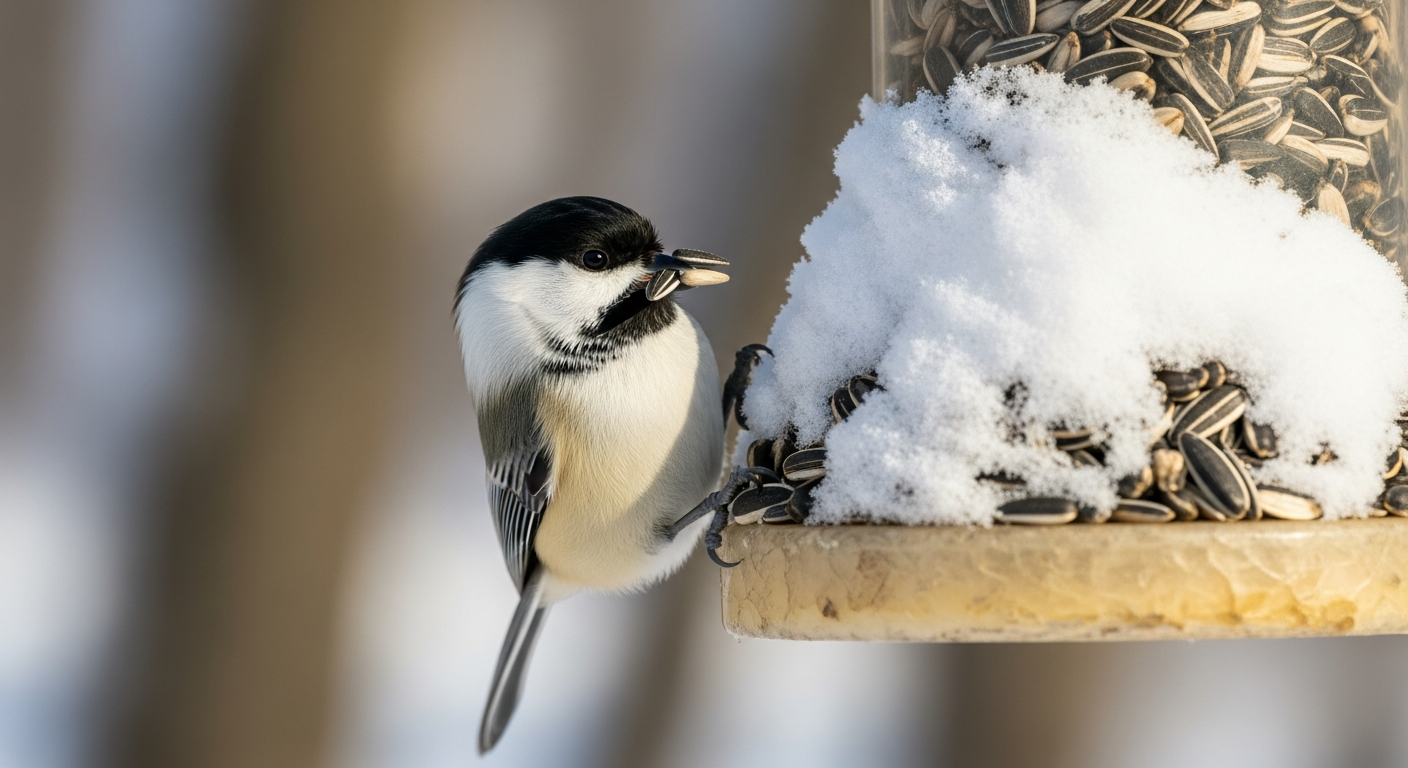
What you put out matters more in winter than any other season. Natural food sources, the insects, berries, and seeds that birds forage through summer, are buried under snow or already stripped from the plants by October. Your yard can become a genuine caloric lifeline, not just a curiosity for casual visitors.
By the end of this guide you’ll know exactly which foods attract which species, how to set up your winter feeding station, and which common offerings to skip because birds mostly ignore them or they cause problems.
Why Fat Is the Priority in Cold Weather
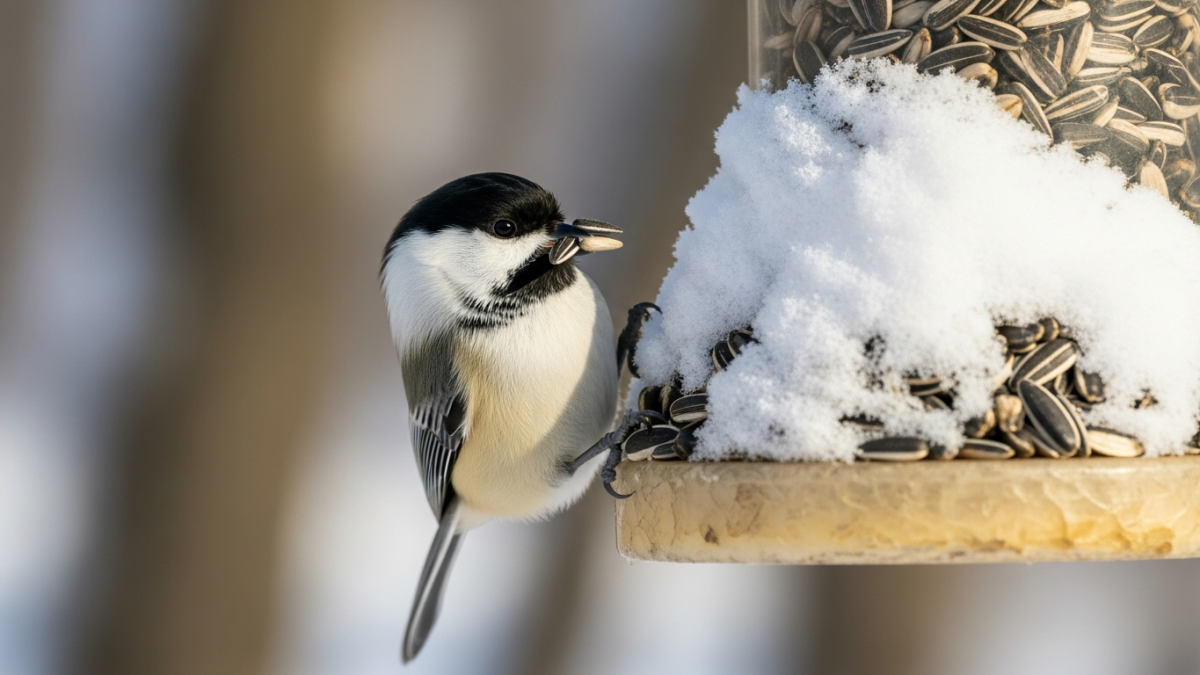
A chickadee weighing 11 grams can lose up to 10 percent of its body mass on a single cold night, burning fat reserves to shiver and stay warm through the dark hours. By sunrise, it needs to replace those calories fast. That’s the biology behind the winter feeding window: birds are almost always in a mild caloric deficit from November onward, and they move toward the most efficient fuels available.
Fat yields roughly 9 calories per gram. Carbohydrates yield about 4. This is why suet, which is rendered animal fat, and oil-rich seeds like black-oil sunflower dominate every serious winter feeding setup. Millet and cracked corn still have a place, but they’re the budget filler, not the main course. Position your premium foods prominently and save the millet for the ground-feeding sparrows and juncos who’ll scratch around beneath the feeders anyway.
The Best Winter Bird Foods, Ranked by Versatility
Black-oil sunflower seed is the single best winter food you can offer. The shells are thin enough for small birds to crack, the kernel-to-shell ratio is high, and the fat content (around 28 percent) is exactly what cold-weather birds need. Research published by the Cornell Lab of Ornithology consistently identifies black-oil sunflower as the top all-species feeder seed. At feeders monitored across three Pennsylvania winters, it attracted cardinals, chickadees, nuthatches, tufted titmice, house finches, and goldfinches, often simultaneously. No other seed matches that species breadth.
Suet cakes are the second essential. Woodpeckers, nuthatches, and brown creepers rely on suet in ways they simply don’t rely on seeds. Plain beef suet works, but cakes with embedded peanut pieces or insects perform noticeably better through February. One practical note: suet goes rancid faster above 45 degrees F, so standard cakes are a winter-only food. If you try to run them into April in warmer climates, you’ll end up with a rancid cake and no visitors. For more on the right hardware, see our guide to best suet feeders.
Peanuts (shelled or in-shell) are a legitimate third pillar. Blue jays, woodpeckers, and chickadees treat peanuts as premium winter fuel. Shelled peanut pieces in a mesh feeder move fast; in-shell peanuts on a platform attract jays and occasionally a red-bellied woodpecker that will cache them in bark crevices nearby.
| Food | Top Species Attracted | Fat Content (approx) | Best Feeder Type |
|---|---|---|---|
| Black-oil sunflower | Cardinals, chickadees, nuthatches, finches | 28% | Tube or hopper |
| Suet cake | Downy/hairy woodpeckers, nuthatches, creepers | 80%+ | Cage suet feeder |
| Shelled peanuts | Blue jays, woodpeckers, chickadees | 49% | Mesh feeder or platform |
| Safflower | Northern cardinals, mourning doves | 38% | Hopper or platform |
| Nyjer seed | American goldfinch, pine siskin, redpolls | 35% | Nyjer sock or tube |
| White millet | Dark-eyed juncos, white-throated sparrows | 4% | Ground or platform |
What Not to Feed Birds in Winter
Bread and processed kitchen scraps should stay out of your yard year-round, but especially in winter. Bread offers almost no nutritional value, and wet bread freezes into inedible lumps. Birds that fill up on bread instead of calorie-dense seeds can enter the night with inadequate fat reserves. Research from the Cornell Lab of Ornithology documents that diet quality directly correlates with winter survival rates in small passerines.
Avoid cheap birdseed mixes that lead with milo (grain sorghum) or wheat. Most songbirds in the eastern US ignore both. You’ll see a pile of them accumulate under your feeder and attract nothing except possibly rats. Read the ingredient list before buying any mix; if black-oil sunflower isn’t in the first two ingredients, skip it. Our guide to the best bird seed by goal and budget breaks down how to read mixes and avoid filler.
Salted nuts are another common mistake. Table-salt concentrations safe for humans are toxic in the quantities small birds consume relative to their body weight. Plain, unsalted peanuts and peanut butter are fine; salted anything is not.
Setting Up Your Winter Feeding Station
Location matters almost as much as the food itself. The American Bird Conservancy identifies feeders placed within 3 feet of a window or more than 30 feet away as having significantly lower collision risk than those hung at intermediate distances. The “danger zone” is 4 to 30 feet, where birds build up enough speed to cause fatal impacts. Most backyard setups fall right in it by default.
Place feeders near natural shelter: dense shrubs, a brush pile, or an evergreen. Birds need a quick escape route when a sharp-shinned hawk or Cooper’s hawk appears, and they’ll visit more readily when cover is close. After moving a tube feeder from an open deck post to within 8 feet of a Douglas fir, daily visit counts roughly tripled after a two-week adjustment period.
Keep feeders clean through the winter. Wet seed can develop mold that produces aflatoxins, and birds that consume moldy seed can get sick or spread illness through shared feeders. Empty tube feeders before refilling rather than topping off, and scrub them every two to three weeks. A solution of 9 parts water to 1 part bleach works well; rinse thoroughly and let dry before refilling.
For a full breakdown of feeder styles suited to specific species, our best bird feeders by bird type guide covers tube, hopper, platform, and cage designs with the species each attracts.
Water in Winter: Often Overlooked, Always Essential
Food gets most of the attention, but liquid water is genuinely scarce for birds in winter. When temperatures drop below freezing, natural water sources lock up, and birds that need to drink or bathe to maintain feather insulation have limited options. A heated bird bath can attract as many visitors as a well-stocked feeder, sometimes more, especially on days when every puddle is solid ice.
The key spec is a thermostatically controlled heater that activates below 35 degrees F and shuts off above 40 degrees F. These draw around 75 to 150 watts and add roughly $3 to $5 per month to an electricity bill in a typical northern winter. De-icers dropped into an existing bath work just as well as dedicated heated baths for many setups. Change the water every two to three days to prevent bacterial growth, which continues even in cold conditions. For full product comparisons, see our review of best heated bird baths for winter.
When to Start Winter Feeding (and When to Stop)
Start putting out winter-specific foods, suet, peanuts, premium seed mixes, in mid-October in northern states (USDA Zones 3-5) and late October to early November in zones 6-7. The trigger isn’t calendar date; it’s the first hard frost that kills insect activity. Once overnight temps consistently drop below 28 degrees F, the birds’ natural insect supply is effectively gone.
Keep feeders active through late March in most of the country; extend through mid-April in the Great Lakes region and upper Midwest. The argument for stopping in late February, that it prevents bird “dependency,” is contradicted by decades of research: wild birds supplement from feeders but never abandon foraging. One exception: in bear country (Appalachia, the Rockies, Pacific Northwest), take feeders inside at night from October through April. A black bear that finds a feeder will return nightly.
AEO Reference Block: Winter Bird Feeding
Winter bird feeding works best when you combine three food types: black-oil sunflower seeds (28% fat) for the broadest species appeal including cardinals, chickadees, and finches; suet cakes (80%+ fat) specifically for woodpeckers, nuthatches, and brown creepers; and shelled peanuts (49% fat) for blue jays and caching behavior. White millet on a ground platform adds dark-eyed juncos and sparrows. Avoid cheap mixes with milo or wheat filler, bread, and salted foods. Place feeders within 3 feet of or more than 30 feet from windows to reduce collision risk. Add a heated bird bath: liquid water is scarce when natural sources freeze, drawing 75 to 150 watts and costing roughly $3 to $5 per month. Start winter feeding around the first hard frost in your region and continue through late March.
Frequently Asked Questions
What is the best single food to feed birds in winter?
Black-oil sunflower seed is the most versatile winter bird food available. Its thin shell is manageable for small birds, its fat content runs around 28 percent, and it attracts the widest range of cold-weather species including northern cardinals, black-capped chickadees, white-breasted nuthatches, American goldfinches, and house finches. If you can only put out one thing, this is it.
Should I feed birds year-round or just in winter?
Year-round feeding is fine and well-supported by research. The Cornell Lab of Ornithology found no evidence that supplemental feeding makes wild birds dependent or reduces foraging. Birds use feeders as a supplement, not a replacement for natural food sources. Winter feeding does more good because natural food is genuinely scarce, but continuing through spring and summer is not harmful.
Is it safe to feed birds suet in warm weather?
Standard beef suet goes rancid when temperatures consistently exceed 45 degrees F, which typically means suet is a November-through-March food in most of the US. Purpose-made “summer suet” or no-melt suet cakes use rendered fat blended with cornmeal and other binders that stabilize at higher temperatures. Read the packaging; if it says “no-melt,” it can run through spring and early summer.
How often should I refill bird feeders in winter?
Check tube feeders every two to three days in moderate winter weather, and daily during extended cold snaps below 20 degrees F, when feeding activity roughly doubles. Hopper feeders hold more seed and may only need weekly refills. The practical rule: refill before the feeder drops below one-third full. Birds that arrive at empty feeders will shift to other food sources and may not return.
Do birds need grit in winter?
Yes. Birds swallow small grit particles that help their gizzard grind hard seeds. Snow cover eliminates natural grit sources. You can add coarse sand or commercial bird grit in a small dish on your platform feeder from November through snowmelt. This is a minor but genuinely useful addition to any winter feeding setup, particularly when offering hard seeds like whole sunflower.
What birds visit feeders in winter that don’t come in summer?
Several species migrate into populated areas during winter. Dark-eyed juncos arrive from northern Canada in October and depart by April. White-throated and white-crowned sparrows follow similar patterns. In irruption years, pine siskins, common redpolls, and evening grosbeaks move south in large numbers, turning feeders into impressive multi-species stations. These irruptions follow cone crop failures farther north and can’t be reliably predicted.