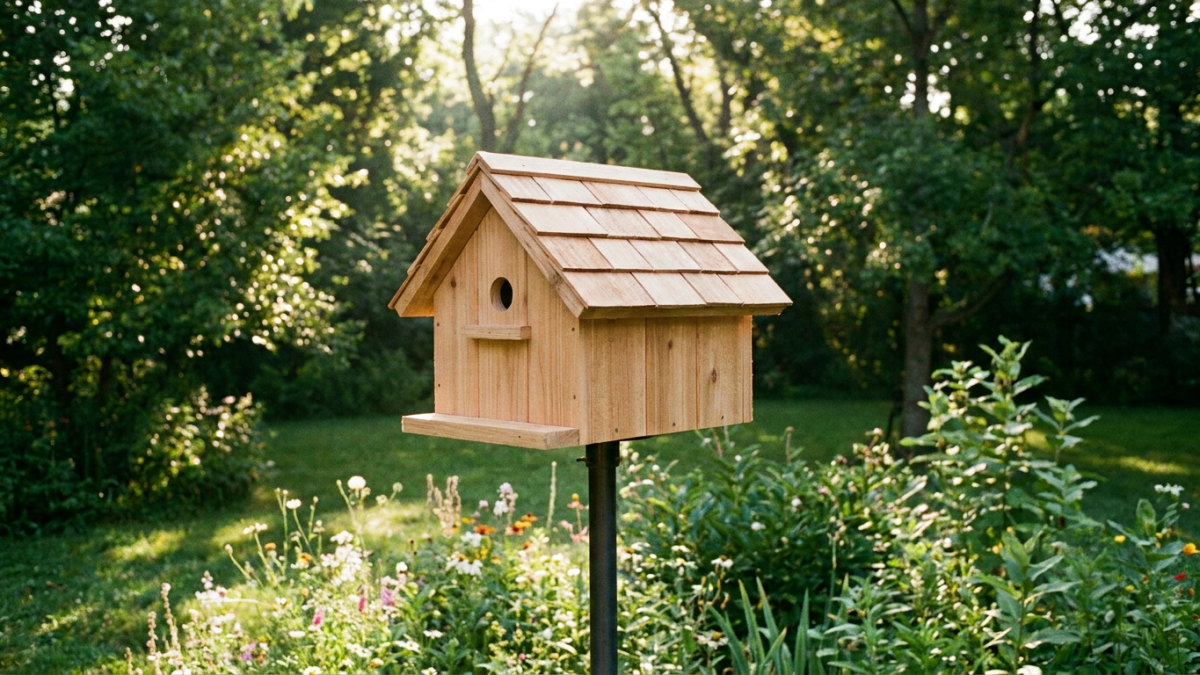
A bird house gets occupied or ignored based on four numbers: floor size, entrance hole diameter, hole height above the floor, and mounting height. The carpentry can be rough. Get the numbers wrong and you built a decorative box; get them right and chickadees or bluebirds will fledge chicks in it by summer.
The dimensions, by species
- Eastern bluebird: 4 by 4 inch floor, 1.5 inch entrance hole, hole about 7 inches above the floor, box on a pole 5 to 6 feet up facing open grass.
- Black-capped chickadee: 4 by 4 floor, 1 1/8 inch hole, hole 6 to 8 inches above the floor.
- House wren: 4 by 4 floor or smaller, 1 inch hole; the one tenant happy near brush and trees.
- Tree swallow: 5 by 5 floor, 1.5 inch hole, box near water.
These match the dimension charts published by Cornell’s NestWatch project, the reference most monitoring programs use. Hole diameter does the sorting: a 1.5 inch hole admits bluebirds and swallows while excluding starlings, and tightening to 1 1/8 keeps the box chickadee-only. The hole size guide goes deeper on which species each diameter admits.
A cut list for one board
You can cut a full box from a single 1 by 6 plank. Back 14 inches, front 9, sides 10 at the back tapering to 8 at the front so the roof sheds water, floor 4 by 4, roof 6 by 8 for overhang. Rough the inside face of the front board with saw kerfs so fledglings can climb out, leave 1/4 inch ventilation gaps where the sides meet the roof, and clip the floor corners for drainage.
The part plans never mention
Two failure modes. A box nailed to a tree trunk or fence post with no baffle feeds raccoons and squirrels, which clean out nests nightly; mount on smooth metal pipe with a stovepipe baffle instead. And an occupied box you never check becomes a house sparrow factory, since sparrows nest in anything and outcompete the natives you built for. If bluebirds are the goal, pair this with the bluebird attraction guide and monitor weekly through the season, or run the backyard birding checklist to sequence the rest of the yard.