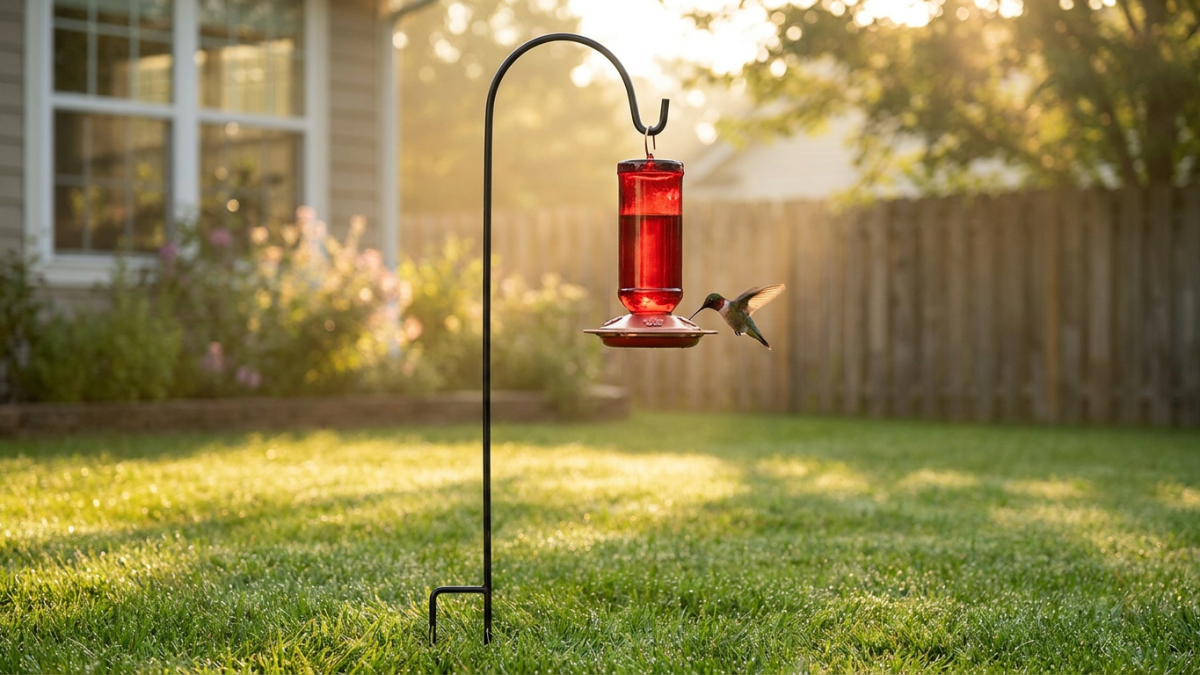
A hummingbird feeder stand works when three things line up: the base is anchored so it does not sway, the load stays light and balanced, and the feeder hangs where you can see it from the window you actually use. For one nectar feeder in a treeless yard, a short steel hook with a stabilizer leg is enough. Several feeders call for a taller pole set in a ground socket.
What separates a sturdy stand from one that tips
Hummingbird hooks rarely come with a wind rating or a load limit, so you have to read the construction instead. Look for solid steel rather than thin hollow tube, a stabilizer leg or multi-prong base, and a ground socket instead of a bare spike.
Perky-Pet’s own reply to a wobble complaint on its More Birds 78 inch pole points at the ground, not the steel: drive the ground socket fully into the soil, seat the pole sections firmly, and add stabilization in loose or sandy ground.
Every extra arm also pulls the center of gravity off the pole. Before you buy a four-arm station, work out how many hummingbird feeders you need. Two single stands spaced apart are steadier than one crowded crossbar, and one territorial male cannot guard both.
Video: Robbie and Gary Gardening Easy
Freestanding stand figures from the makers
The table lists what each listing actually publishes. Notice how few give a load limit at all.
| Stand | Height | Build | Hanging points | Base | Published load limit | Source |
|---|---|---|---|---|---|---|
| More Birds 42 Inch Hummingbird Hook (38021) | 42 in from the ground | Solid steel, powder-coated | 1 hook | Built-in stabilizer leg | Not published | perkypet.com, street price $22.19 |
| More Birds 78 Inch Bird Feeder Pole (38128) | 78 in above ground once installed | Solid steel, powder-coated | Double hanger | Ground stake socket | Not published | perkypet.com |
| Stokes Select 60 Inch Bird Feeder Pole | 60 in installed | Metal, 1 in diameter | Accepts add-on accessories | Not stated in listing | Not published | Lowe’s listing |
| Woodlink 3 Piece Pole Kit (25276) | 72 in pole | 3-section pole, 1 in outer diameter | 6.5 x 2 in mounting plate | Ground socket | Up to 30 lb | woodlink.com; load figure from Bluebird Landing listing |
Plumelore earns a commission on qualifying Amazon purchases made through these links, at no extra cost to you.

Set the height by your window, not the box
Height decides whether you see the birds at all. Stand at the window you watch from, note where your eye line meets the yard, and pick a stand that puts the feeding ports near that level.
Distance from the glass matters just as much. Cornell Lab’s All About Birds advises placing feeders closer than 3 feet to a window, and Cornell’s K-12 feeder guidance gives the other safe option: more than 30 feet away. In between, a bird leaving the feeder builds enough speed to hit the glass hard.
A 42 inch hook suits a seated view from a ground-floor room. A 78 inch pole fits a standing view or a deck.
Single hook or multi-arm station
A plain hook is cheap, light and easy to move when you chase a better sightline. A multi-arm pole holds more, but it needs a deeper anchor and a baffle if squirrels raid your seed feeders on the same arm. The trade-offs are laid out in our comparison of a freestanding bird feeder stand vs a shepherd’s hook.
Where stands wear out
Powder coat chips first at the hook tip, where the hanger rubs, and rust follows. Check the ground socket each spring too, since frozen soil can push it loose over winter.
The feeder usually gives out before the stand does. Ports, bee guards and seals have their own lifespan, covered in which hummingbird feeder parts wear out first.