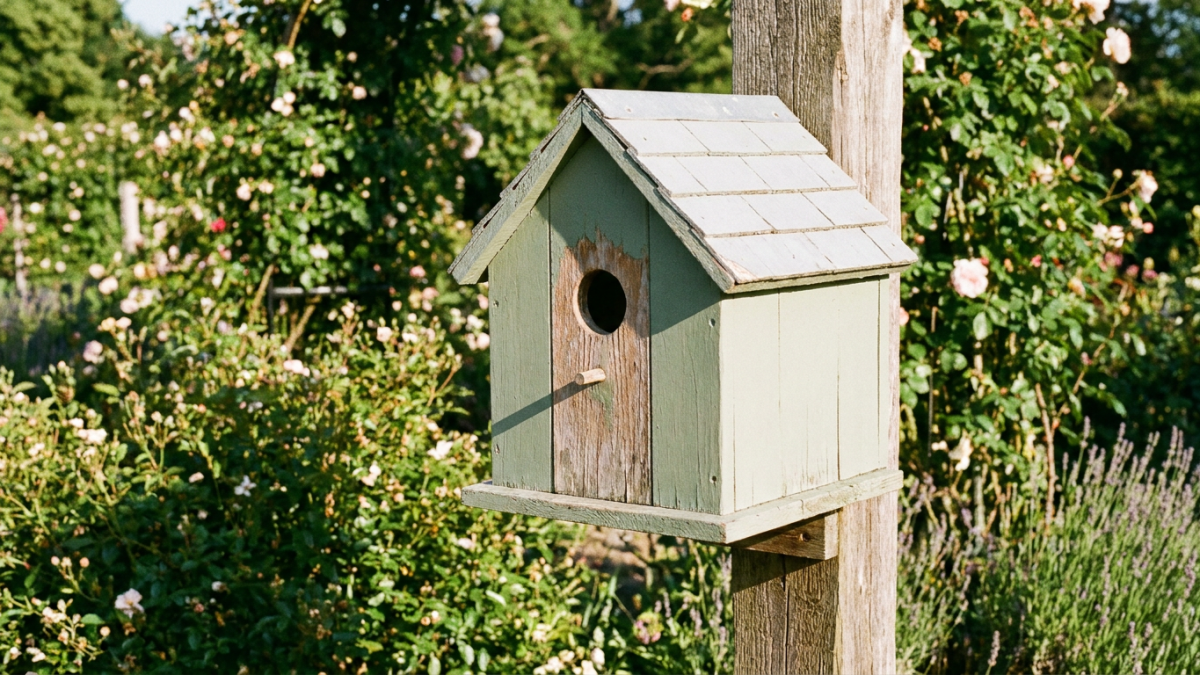
The best birdhouse painting ideas keep the color on the outside, keep it light, and leave every surface a bird touches as bare wood. Paint the exterior walls and roof in white, tan, gray or dull green. Never paint the interior, the floor or the entrance hole.
Most craft tutorials skip that second half. A box can look great on a shelf and still fail as a nest.
Where paint goes and where it never goes
Cornell Lab’s NestWatch says outright that it recommends untreated, unpainted wood, because no conclusive study shows whether residual paint fumes harm birds. If you paint anyway, NestWatch limits it to the exterior.
Connecticut’s wildlife agency is blunter: never stain or paint the inside of the box or the entrance hole. The Purple Martin Conservation Association says wooden houses should keep a natural, unpainted interior.
The reason is contact. Nestlings sit against those walls for weeks, and adults grip the hole rim on every trip in.
Video: Bird Brain
Light colors keep the box cooler
Dark exterior paint soaks up sun, and a small cavity has little room to shed that heat. NestWatch notes that monitors in climates regularly above 95 degrees F sometimes paint the exterior light specifically to cool the box.
The North American Bluebird Society points you toward earth tones such as light green, gray or brown, or white, to reflect sunlight.
Muted colors also help with predators. NestWatch prefers tan, gray or dull green for most cavity nesters because they are less conspicuous. White is the exception, and it belongs on Purple Martin housing, where the PMCA requires a white exterior.
Paint is the backup, though. A 2 inch roof overhang and proper vents do more for heat, which is why good bird house designs build the shade in rather than relying on a coat of color.
Safe finishes and decorating ideas that still work
Use water-based exterior latex or a light water-based stain. NABS names water-based paint or stain as the right sealer for pine and exterior plywood. Skip pressure-treated lumber entirely, since it carries pesticide and fungicide.
Timing matters more than brand. NestWatch warns that even zero-VOC and low-VOC latex can release fumes for months or years, so paint in fall and let the box air out over winter.
You still have room to decorate:
- Two-tone schemes: a sage body with a gray or white roof.
- A painted roof only, leaving natural cedar walls.
- Stenciled leaves or a house number on the front panel, kept well away from the hole.
- Decorative boxes painted any color you like, hung as garden art rather than as nest sites.
Leave out glitter and any finish on the hole rim, the one spot every adult grips on every visit.
Check dimensions before you pick up a brush. Many bird house kits ship with thin walls or no vents, and no paint job fixes that. Confirm the bird house hole size matches your target species, then paint.
| Surface or choice | Guidance | Source |
|---|---|---|
| Interior walls and floor | Leave unpainted, untreated wood | NestWatch; PMCA |
| Entrance hole | Never paint or stain | Connecticut DEEP |
| Exterior, most cavity nesters | Light colors: tan, gray, dull green | NestWatch |
| Exterior, bluebird boxes | Earth tones (light green, gray, brown) or white | NABS |
| Exterior, Purple Martin housing | White | PMCA |
| Paint type | Water-based paint or stain | NABS |
| Pressure-treated wood | Avoid | NestWatch |
| When to paint | Fall, so fumes dissipate over winter | NestWatch |
| Roof overhang | 2 in over the sides for shade | NestWatch |
| Wall thickness | 3/4 to 1 in solid wood | NABS |
Sources: NestWatch paint and treated wood FAQ, PMCA housing guidance, NABS nestbox recommendations, Connecticut DEEP bluebird nest boxes.