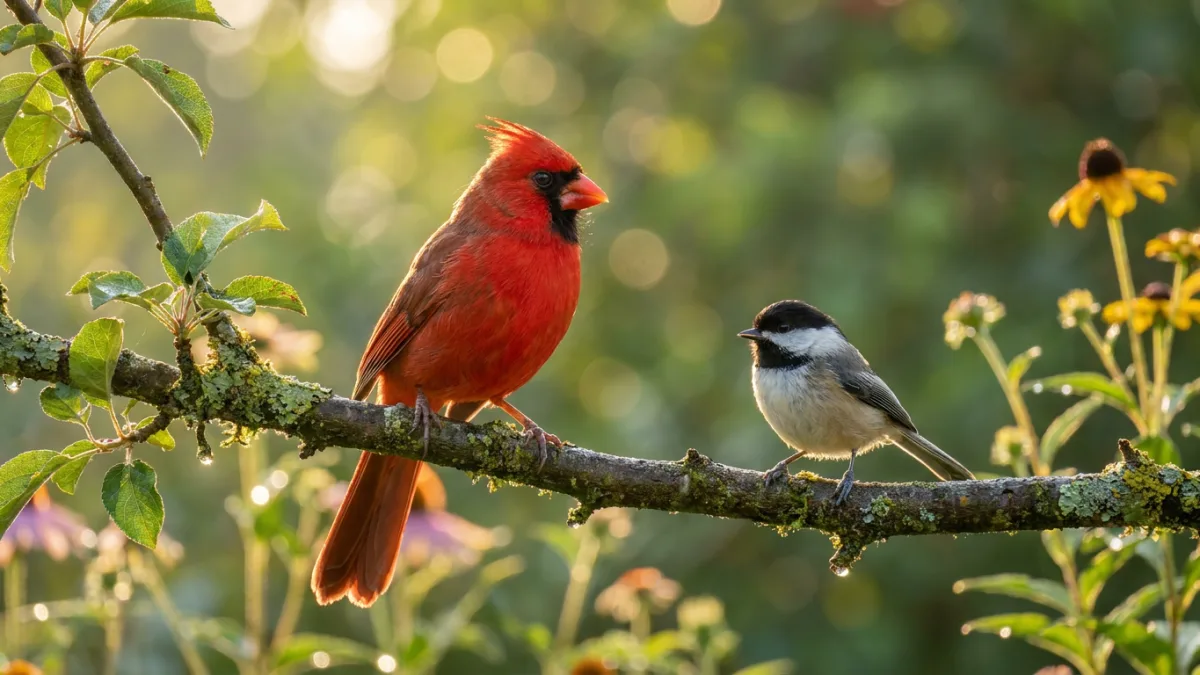
You can identify many backyard birds by song before you ever see them. Seven of the easiest to learn by ear are the American robin, Northern cardinal, black-capped chickadee, mourning dove, blue jay, song sparrow, and Carolina wren.
Each has a phrase or rhythm that stays consistent. Once it clicks, you will hear these birds everywhere.
The seven songs worth learning first
- American robin: a cheerful, rolling “cheerily, cheer up, cheer up,” often the first voice at dawn. More in how to attract robins.
- Northern cardinal: clear, whistled “birdy-birdy-birdy” or “cheer-cheer-cheer,” and both males and females sing.
- Black-capped chickadee: a two-note “fee-bee” whistle plus the namesake “chick-a-dee-dee,” covered in how to attract chickadees.
- Mourning dove: a soft, mournful “coo-OO-oo-oo” that people often mistake for an owl.
- Blue jay: a harsh “jay-jay” scream, plus a surprising talent for mimicking hawks.
- Song sparrow: a few sharp notes followed by a buzzy trill, sung from an open perch.
- Carolina wren: a loud, ringing “teakettle-teakettle” from a bird smaller than your fist. More in how to attract wrens.
How to learn songs that stick
Start with one bird at a time. Pick a species you already see at the feeder and match its call to the bird in front of you.
Use a simple word phrase as a hook. “Teakettle” for the wren or “cheeseburger” for the chickadee gives your memory something to grab.
Why birding by ear beats looking
Sound reaches farther than sight through leaves and fences. You will detect birds you would never spot, especially in dense yards.
It also works at dawn, when the chorus peaks and many birds stay hidden. Learning songs turns a quiet backyard into a busy one you can actually track.