A woodpecker sound is either drumming or a call, and you can split the two in one listen. Drumming is a burst of bill strikes on wood or metal, usually about a second long and too fast to count. A call is a vocal note or series, pitched and shaped like any other bird’s voice.
Cornell Lab of Ornithology describes drumming as the woodpecker equivalent of singing.
Drumming is the song, and the tempo names the bird
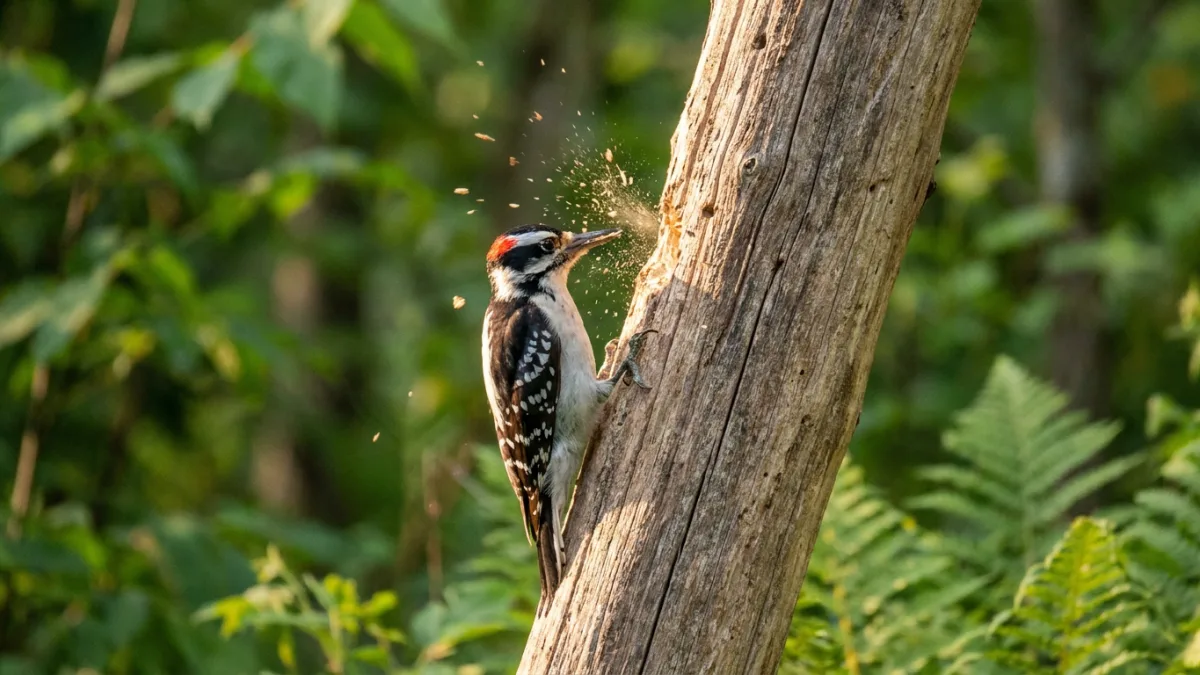
Woodpeckers drum to claim territory and attract a mate, and they pick the most resonant surface available, which explains gutters, chimney flashing and street signs. Cornell notes the Yellow-bellied Sapsucker drums on metal specifically to amplify the message.
The tempo is the identifier. Cornell puts the Hairy Woodpecker at about 26 beats in roughly one second, the Northern Flicker at around 25 strikes in a second-long roll, and the male Red-bellied Woodpecker at about 19 beats per second.
The Pileated Woodpecker is the outlier: a slow, deep roll lasting about 3 seconds. Sapsucker drumming stutters, with irregular gaps that Cornell compares to morse code.
Those beat counts only help on a slowed-down recording. By ear, 25 and 26 beats are the same blur, so in the field judge length and rhythm instead.
Video: Badgerland Birding
Calls carry pitch, and pitch separates the look-alikes
Calls come from the voice, so they rise or fall. The Downy Woodpecker gives a whinny of hoarse, high notes that descends in pitch and lasts about 2 seconds. The Hairy Woodpecker rattles too, but its version holds pitch to the end, and its single peek note sits slightly lower.
That descending tail is often a better clue than size when you are sorting a downy vs hairy woodpecker at the feeder.
The flicker’s kyeer is a single loud note about half a second long. The Red-bellied Woodpecker rolls a shrill kwirr or churr. The Pileated pipes a high, clear series that runs several seconds, and gives a short wuk or cuk at a territory boundary.
Drum and call figures by species
All figures are from the Cornell Lab All About Birds species accounts.
| Species | Drum (Cornell Lab) | Signature call (Cornell Lab) |
|---|---|---|
| Downy Woodpecker | Very rapid strikes at a steady pace, no count published | Descending whinny, about 2 seconds; sharp pik |
| Hairy Woodpecker | About 26 beats in about 1 second, evenly paced | Sharp peek; rattle that does not descend |
| Red-bellied Woodpecker | About 19 beats per second for about 1 second (males) | Rolling kwirr or churr; coughing cha cha cha |
| Northern Flicker | Around 25 strikes in about 1 second, evenly spaced | Single kyeer, about half a second; wick-a wick-a |
| Pileated Woodpecker | Slow, deep rolling, about 3 seconds | High piping series lasting several seconds; wuk or cuk |
| Yellow-bellied Sapsucker | Slower and irregular, stuttering cadence | Scratchy nasal mewing; squealing quee-ah |
The quiet tapping and the knocking on your house
Most audio clips skip a third sound. Cornell describes a slow, deliberate and much quieter tapping that a Downy makes while excavating, which can itself draw a mate. Excavation taps come uneven and soft, while a true drum is loud and evenly spaced.
Racket on your siding at dawn in late winter is almost always drumming on a resonant panel, and the bird is advertising rather than eating.
Whether the same bird is also drilling for insects is a separate question with a different fix. The guide to attracting woodpeckers without losing your siding covers both cases.
Three checks before you name the bird
Count the length first. A one-second burst points to downy, hairy, flicker or red-bellied. Three seconds of slow rolling says pileated, and a broken stutter says sapsucker.
Then listen for pitch. A drum has none and a call always does, so any note that rises or falls is a vocalization.
Finally, match the call shape to the table and confirm with a look. The run-down of backyard birds you can identify by song applies the same habit to the rest of the yard.