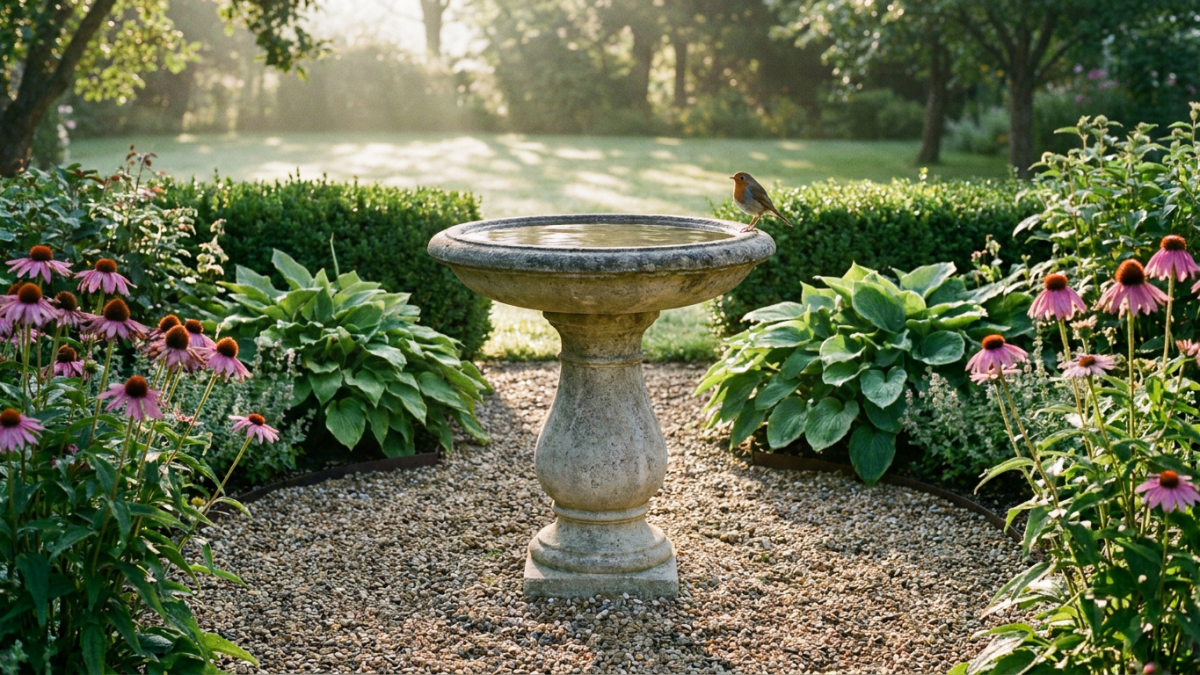
Put a garden bird bath in open ground about 10 to 15 feet from the nearest dense shrub, on the shaded side of a bed you do not mind getting wet, and empty it every two or three days. That spot covers all three jobs: birds see a cat coming, plants stay out of the splash, and mosquitoes never finish a life cycle.
Sightlines to cover, not cover itself
A bathing bird is soaked, heavy, and slow. It wants a perch it can reach in one short flight, but it does not want a hedge pressed against the rim where a cat can wait unseen.
The gap most backyard guides settle on is 10 to 15 feet of open air: close enough to bolt to, far enough that nothing ambushes from underneath. We go through the species side of this in the best bird bath placement to attract species.
Give the bath a clear view on at least two sides; a pedestal that feels exposed to you reads as safe to a chickadee.
Video: Yard To Jungle
Splash and what it does to your beds
A busy bath throws water, and a fountain or dripper adds mist that lands well past the rim on a breezy day.
That is fine for a gravel circle or a patch of hostas. It is a problem for plants that hate wet crowns: lavender, sedum, most Mediterranean herbs, and anything sold as drought-tolerant. Constant damp at the base rots them.
The practical fix is a ring of gravel or flagstone under and around the bath, roughly a foot wider than the bowl on all sides. It takes the splash and drains fast.
If you run moving water, the splash radius grows. Read what moving water changes in a bird bath before you set a fountain next to a rose bed.
Depth, sun, and the mosquito clock
The Cornell Lab of Ornithology puts the working depth at no more than 1 inch at the edge, sloping to 2 inches in the center. Deeper than that and small birds stand on the rim and leave.
| Placement variable | Figure | Source |
|---|---|---|
| Water depth at the edge | 1 inch maximum | Cornell Lab of Ornithology |
| Water depth at the center | 2 inches maximum | Cornell Lab of Ornithology |
| Open ground to nearest shrub | 10 to 15 feet | Common backyard birding guidance |
| Aedes mosquito, egg to adult | 7 to 10 days | CDC |
| Anopheles mosquito, egg to adult | 10 to 14 days | CDC |
| Water refresh interval | Every 2 to 3 days | Derived from the CDC cycle |
Partial shade slows evaporation and algae; full sun in July turns a shallow bowl into warm soup by afternoon. The fix for that is in how to keep a bird bath from turning green.
Mosquitoes are a timing problem, not a placement one. The CDC gives Aedes species 7 to 10 days from egg to adult, and Anopheles 10 to 14. Dump and refill every two or three days and no larva ever gets close to the finish line.
A dripper or wiggler that keeps the surface moving also discourages females from laying.
Where it goes in the garden picture
A pedestal bath is a focal point, so treat it like one. Set it at the end of a path, in the curve of a border, or where you see it from the kitchen window.
Keep it off the lawn edge where the mower throws clippings, and well away from the feeder so seed hulls do not end up in the water. A bath you can see and reach with a hose is a bath you will keep full.