A bird bath is the fastest way to bring birds into a small garden, and the fastest way to lose them again is to let the water go bad. Birds drink the same water they bathe in, and they are not picky about it. A bath that sits for a week grows algae, collects droppings and leaf litter, warms up, and becomes a good place for disease organisms and a perfect one for mosquito larvae. The fix is a short routine on a fixed schedule, with cleaners that will not hurt the visitors you are trying to attract.
Why the schedule matters more than the scrub
Wild birds share diseases at standing water. Trichomoniasis, salmonella and avian pox all pass between birds at dirty baths and feeders, and outbreaks in gardens are usually traced back to one bath that nobody emptied. The organisms thrive in warm, organic-rich water, which is exactly what a bath becomes after a few busy days of bathing.
Mosquitoes are the second clock. Mosquito larvae need roughly a week in standing water to develop into adults, so any bath left untouched past five or six days in summer is actively breeding them. Emptying the water every two to three days breaks the cycle completely, no chemicals required.
Audubon’s standing advice is to empty and rinse a bird bath every couple of days and to give it a real scrub weekly. In practice, in summer heat, treat that as a maximum rather than a target.
The routine cleaning method
Daily to every second day: dump the water out completely, rinse the basin with fresh water, give it a quick sweep with a stiff brush to loosen droppings and film, and refill with clean water. This takes about two minutes and does most of the work of keeping the bath safe.
Weekly: the deeper clean. Empty the bath, then scrub the whole basin with a stiff brush and a cleaning solution while the surface is still damp. The safest everyday option is a white vinegar solution, roughly nine parts water to one part vinegar, which cuts algae and biofilm without leaving residues that harm birds. Scrub the rim carefully; that is where birds land and drink, and where droppings accumulate. Rinse thoroughly, several times, until no smell of vinegar remains, then refill.
If the bath has been neglected and has heavy algae growth or you have reason to think a sick bird used it, use a weak bleach solution instead, one part household bleach to nine parts water. Bleach is more effective against disease organisms, but it must be rinsed exhaustively. Fill, empty and rinse the basin at least three times, and let it air dry in the sun before refilling. Never mix bleach and vinegar.
Two things to avoid: dish detergent leaves a residue that strips the oils from feathers, and it persists in the microscopic texture of concrete and stone baths. And do not add anything to the standing water to keep it “fresh”, no chemicals, no additives. Clean water, replaced often, is the whole method.
The algae line
Some algae is normal. A slight green tint to the water after two summer days, a thin film on the basin, nothing a weekly brush pass cannot handle.
A continuous dark green coating, or visible growth that comes back within a day of scrubbing, means the bath needs a change of position or design. Algae needs sunlight. Moving a bath into light shade cuts growth dramatically. Shallow, dark-bottomed basins heat up fastest and grow algae fastest; lighter-coloured and deeper basins do better. Concrete is porous and holds organic material in its surface, so concrete baths go green sooner than glazed ceramic or metal ones and need the weekly scrub without fail.
Winter and summer adjustments
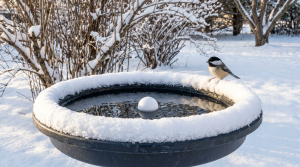
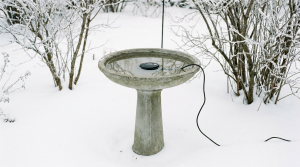
In freezing weather, keeping the bath from icing over helps birds, which need open water for drinking and bathing even when it is cold. Check morning and evening, crack and remove ice, and refill. Do not add anything to the water to lower its freezing point; salt and glycol products are toxic to birds. A dark basin in a sunny spot, topped up with lukewarm water in the morning, holds open water for most of a winter day.
In the peak of summer, evaporation plus heavy use means the bath may need topping up daily. Algae grows faster, so move the weekly scrub forward to twice weekly if the bath sits in full sun.
Where the bath sits changes how often you clean
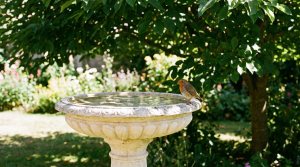
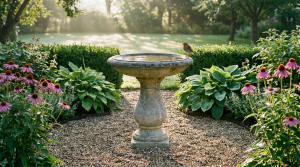
A bath under trees fills with leaves and droppings faster. A bath in the open sun goes green faster. A bath near a feeder collects seed husks and spilled feed. The sweet spot is light shade, a couple of metres of open space around it so birds can see cats coming, and far enough from the feeder that husks are not falling in. If you are setting up from scratch or the current spot is a maintenance problem, the planting and layout logic is covered in our guide to a hummingbird-friendly garden, and how seasons move visitors through a garden is explained in our piece on reading a hummingbird migration map.
The honest summary: a bird bath is a commitment of about two minutes every second day. Do that, scrub weekly, place it sensibly, and the bath stays a safe stop rather than a quiet hazard in the corner of the garden.