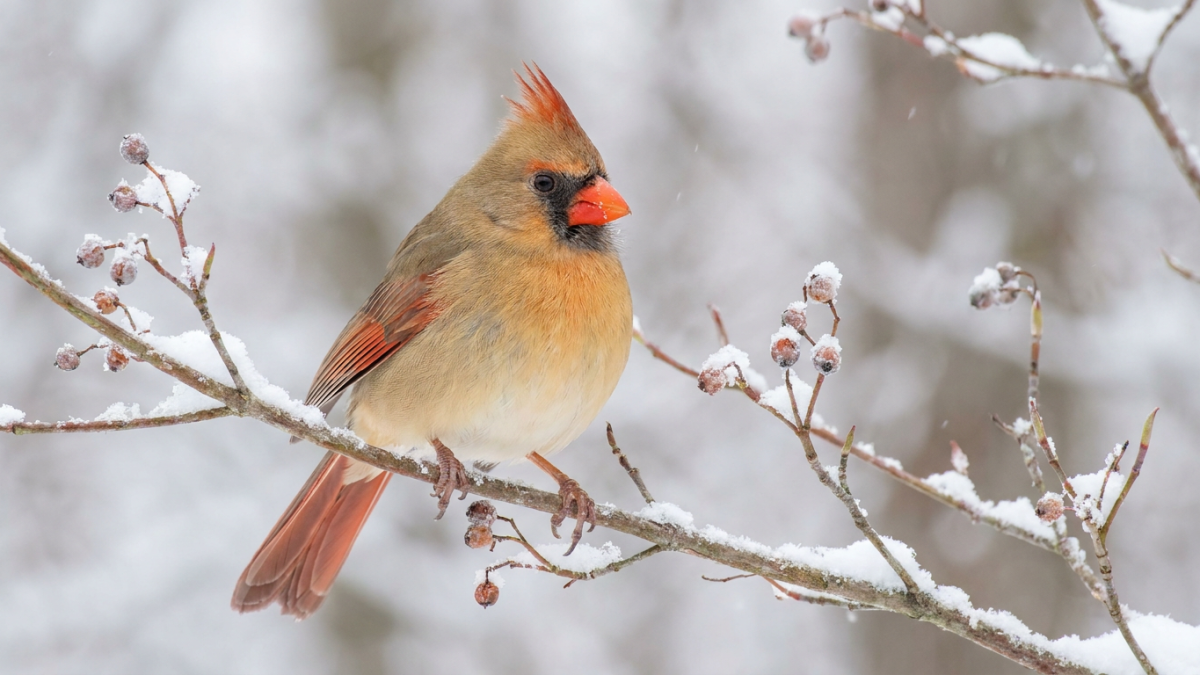
A female cardinal is a pale brown, crested songbird with warm red tinges on her wings, tail and crest, plus the same black face and red-orange bill as the male. If the bill is yellow and the bird is gray, it is a Pyrrhuloxia instead.
Plenty of people see a cardinal-shaped bird in brown and wonder if it is something rarer. It almost never is: the female is simply the quieter-colored half of a pair that stays together on one territory.
Below you get the field marks, the three birds most often mistaken for her, and the seed, feeder and water she is most likely to use.
Plumelore earns a commission on qualifying Amazon purchases made through these links, at no extra cost to you.


How do you tell a female cardinal from a Pyrrhuloxia or a tanager?
Check the bill first. A red-orange bill on a pale brown, crested bird means cardinal; yellow means Pyrrhuloxia, and pale means one of the look-alikes.
| Female bird | Overall color | Bill | Length | Weight |
|---|---|---|---|---|
| Northern Cardinal | Pale brown with warm reddish tinges in wings, tail and crest | Red-orange | 8.3-9.1 in | 1.5-1.7 oz |
| Pyrrhuloxia | Buffy gray with less red than the male | Yellow | 8.3 in | 0.8-1.5 oz |
| Summer Tanager | Yellowish overall, no real crest | Pale, pinkish or horn-colored | 6.7 in | 1.1 oz |
| Rose-breasted Grosbeak | Brown and heavily streaked, with a white eyebrow | Pale, very large and triangular | 7.1-8.3 in | 1.4-1.7 oz |
Descriptions and both-sex measurements from the Cornell Lab All About Birds ID pages, checked October 2026. Prices are not listed because this table compares birds, not products.
Formula: kWh = watts x hours per day x days / 1,000, then times your rate. Assumes the heater draws its full rated wattage whenever it is on.
What does a female cardinal look like?
She is pale brown overall, with reddish tinges in the wings, tail and crest, a black face and a red-orange bill. Cornell Lab lists both sexes at 8.3 to 9.1 inches long and 1.5 to 1.7 ounces, between a sparrow and a robin in size.
Young birds look like her, but a juvenile has a gray to black bill. In late summer you may also meet a female with a bare head: Cornell notes that some birds lose all their head feathers at once and stay bald until the new ones grow in.
Video: Bird Feeder Hub
Do female cardinals sing?
Yes. Cornell says both sexes sing a loud series of clear whistles, and a female sings alone as well as in duets with her mate.
Her chip note and song phrases are covered in our guide to cardinal calls, including what the female is saying during nest-site visits.
What do female cardinals eat?
Mostly seeds and fruit, with insects added in the breeding season. Nestlings are fed mainly insects.
At a feeder, cardinals take many kinds of birdseed, with black oil sunflower the one Cornell singles out. Our breakdown of cardinal bird seed compares sunflower with safflower and the rest.
Cornell also notes that during foraging, females tend to give way to males. A feeder with more than one seat, such as a platform, gives her room to eat without a wait.
Where does a female cardinal build her nest?
Low and hidden. Cornell puts nests 1 to 15 feet up, wedged into a fork of a sapling, shrub or vine tangle in dense foliage.
She does most of the building, which takes 3 to 9 days. The finished cup is 2 to 3 inches tall and about 4 inches across, and she lays 2 to 5 eggs, with 1 to 2 broods a year.
Dense shrubs and a steady seed supply are what keep a pair close, and our tips to attract cardinals to your yard cover both.
Questions people ask about female cardinal
How can you tell a female cardinal from a male?
The male is brilliant red all over. The female is pale brown with warm reddish tinges in the wings, tail and crest. Both have the same black face and red-orange bill, per Cornell Lab.
Do female cardinals have a crest?
Yes, females are crested like males. Cornell notes the crest can be raised and pointed when the bird is agitated, or lowered and barely visible while she rests.
Why does my female cardinal have a bald head?
Most likely a molt. Cornell Lab notes that some birds lose all their head feathers at the same time and stay bald until the new feathers grow back.
Do female cardinals sing?
Yes. Both sexes sing clear whistles that can sound like cheer, cheer, cheer. Cornell says the female sings alone and also in duet with the male.