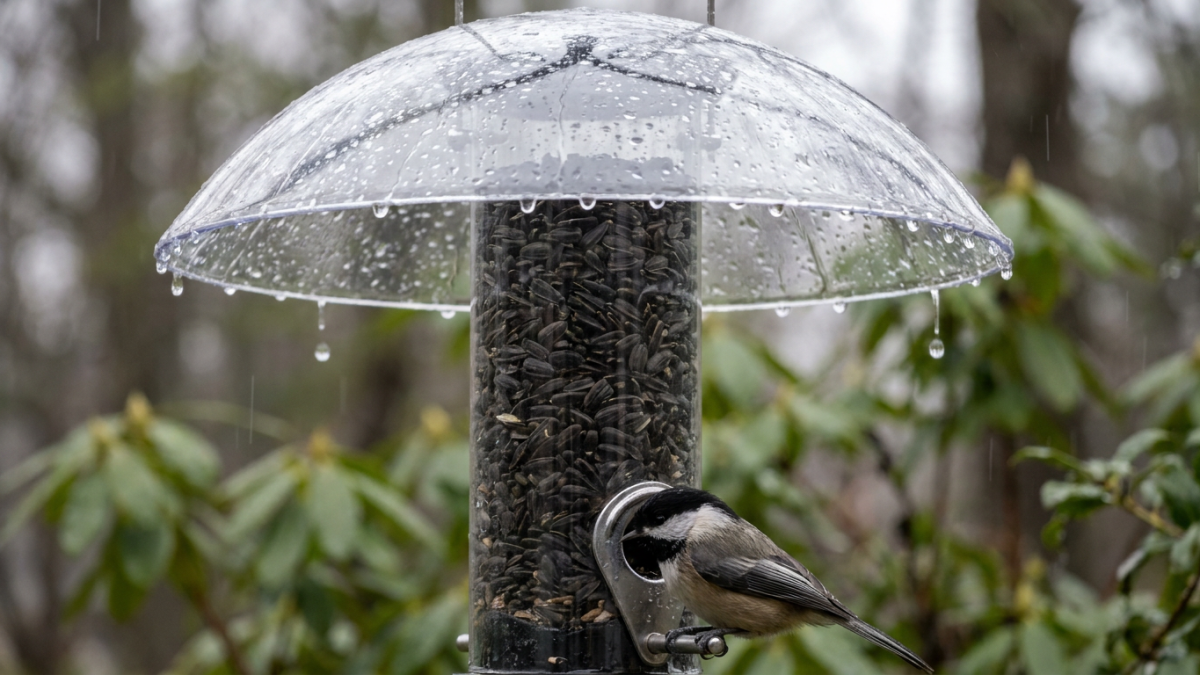
A bird feeder cover, usually sold as a rain dome or weather guard, is a clear disc that hangs above the feeder and sheds rain and snow before it reaches the seed. It is not a squirrel baffle. A baffle is sized to block a climbing or jumping animal, a dome is sized to keep water off the ports, and the two jobs call for different diameters.
If your seed clumps, sprouts or turns gray after every storm, a dome is the fix. If squirrels empty the tube, you want a baffle, and only the largest domes do both.
Dome vs baffle: one shape, two different jobs
Both are domed polycarbonate and makers sell them side by side, so the figures have to separate them. Droll Yankees sells a 10 inch Rain Guard that clamps onto a 2.5 inch tube and does nothing about squirrels, and a separate 15 inch Squirrel and Weather Guard that is rated for both.
Cornell Lab’s guidance for a hanging feeder is a tilting baffle at least 18 inches across, mounted above the feeder. Anything smaller is a weather cover with a side benefit, not a squirrel barrier.
Video: Brome
| Cover | Diameter (maker figure) | Rated to stop | Price seen |
|---|---|---|---|
| Droll Yankees Rain Guard | 10 in, clamps to 2.5 in tubes | Rain and snow only | $19.99 at Bird Watcher’s Supply and Gift |
| Aspects Weather Dome | 12 in wide, 4.125 in tall | Rain and snow, small to medium hanging tubes | Not published on the maker site |
| Droll Yankees Squirrel and Weather Guard | 15 in wide, 13 in tall | Squirrels plus rain and snow | MSRP $59.99 (BFG Supply listing) |
| Aspects Super Dome | 18 in wide, 6 in tall | Rain, snow and squirrels | Not published on the maker site |
| Cornell Lab hanging baffle guidance | At least 18 in, tilting, above the feeder | Squirrels | Guidance, not a product |
What wet seed costs you
Cornell’s Project FeederWatch says to clean seed feeders every week or two, and more often in wet weather, because damp hulls and seed harbor pathogens. A dome does not replace that schedule. It cuts how much seed you throw out between cleanings.
A 2017 study reported by FeederWatch found the parasite Trichomonas gallinae survived only in wet seed, and for up to 48 hours in wet mixed seed held at 98 F. It was never recovered from dry seed. FeederWatch’s feeding guide adds that hulled sunflower spoils faster than seed in the shell, so a cover matters most over a no-mess feeder.
A dome over a tube filled from a damp bag protects nothing, so read how to keep bird seed fresh in storage first.
Picking the diameter for your feeder
Makers size covers by feeder class, not by rainfall. Aspects rates its 12 inch Weather Dome for small to medium hanging tubes and its 18 inch Super Dome for almost any hanging feeder or house. The 10 inch Droll Yankees Rain Guard is a tube-only part and sits right over the top port so the cap stays reachable for refills.
Wind-driven rain still reaches the ports under any dome, and a tray feeder under a 10 inch disc stays wet along the rim. On a pole-mounted setup, check how the cover clears your hook before buying. The bird feeder pole setup guide covers hanger height and baffle spacing.
The cleaning schedule does not change
Cornell’s All About Birds says to clean seed feeders about every two weeks and to soak the parts for 10 minutes in one part bleach to nine parts water. A dome keeps rain off, it does not keep droppings and hulls out. Hold to how often to clean a bird feeder and treat the cover as a way to lose less seed between washes.
One limit a cover cannot fix: in hot, humid weather FeederWatch’s advice is to change seed out regularly and consider bringing feeders in before heavy rain. A dome slows the wetting. It does nothing about humidity.